
Best Hybrid Mattress for Back Support in 2026?
Last Updated: October 25, 2026
Quick Summary
The best hybrid mattress for back support combines a foam comfort layer with pocketed coils that keep your spine in neutral alignment, usually at a medium-firm rating of 6 or 7 out of 10. Choose zoned support with firmer coils under the lumbar area, and match the firmness to your body weight and sleep position.
- Medium-firm, roughly 6 or 7 out of 10, is the usual firmness target for back sleepers.
- Above roughly 230 pounds, look for firm (7-8) with a support core of at least 8 inches.
- Lie on the bed for at least 15 minutes and check the gap under your lower back.
- Most mattresses need replacing every seven to ten years, and back support goes first.
- Most hybrid warranties run 10 years and require sagging beyond about 1 to 1.5 inches.
Table of Contents
- Why a Hybrid Mattress for Back Support Makes Sense in 2026
- The Best Hybrid Mattress for Back Pain: What Actually Matters
- Mattress Firmness for Back Pain: Finding Your Number
- Hybrid Mattress Pros and Cons: An Honest Breakdown
- How Often to Replace a Mattress for Back Support
- Durability, Adjustable Bases, and the Details That Decide
- How We Test Hybrid Mattresses for Back Support
- Compare Hybrid Mattresses and Claim Your Coupon Code
- Frequently Asked Questions
Why a Hybrid Mattress for Back Support Makes Sense in 2026
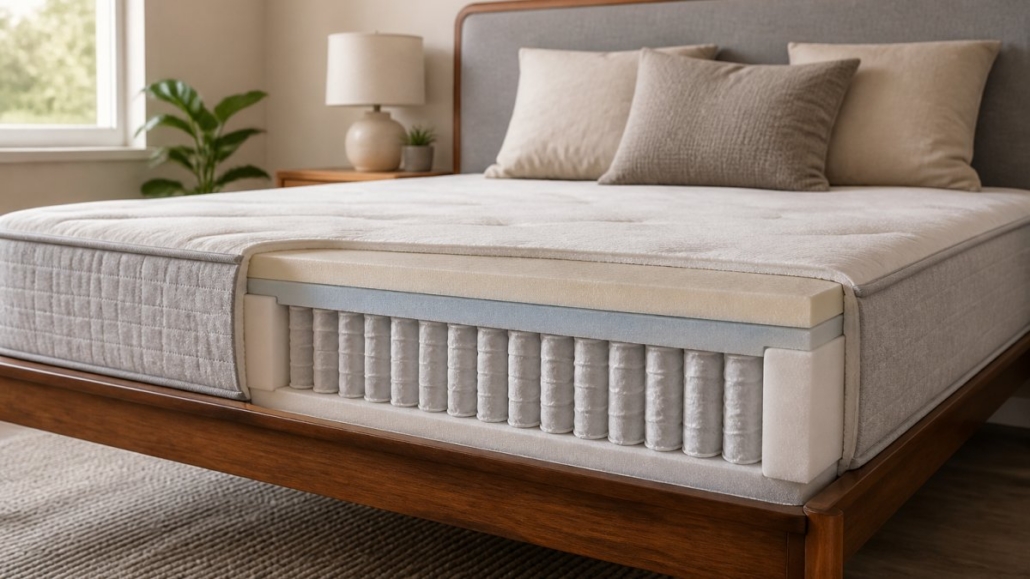
A hybrid mattress combines a foam comfort layer with a pocketed coil support core, and that combination is why it has become the default recommendation for back support.
The American Academy of Orthopaedic Surgeons notes that sleep position and surface support both affect how the spine is loaded overnight, which is why the coil layer matters so much for anyone shopping for the best hybrid mattress for back support.
How Coils and Foam Work Together to Support Your Spine
The foam top layer contours to your curves and eases pressure at the hips and shoulders. The pocketed coils underneath do the structural work: each coil responds independently, pushing back where you need it most. That responsive support keeps your midsection from sinking out of line. Foam alone gives you cushioning. Coils alone give you pushback. Together they deliver both, which is exactly what lumbar support requires.
The Best Hybrid Mattress for Back Pain: What Actually Matters
The best hybrid mattress for back pain is not the firmest one you can find. It is the one that keeps your spine in neutral alignment while still cushioning pressure points.
What most guides miss is that back support is not the same as back-pain treatment. If your pain is persistent, the MedlinePlus overview of low back pain is a sensible starting point before you blame your bed.
Three things decide whether a hybrid works for you:
- Support core: pocketed coils that stay firm under the midsection
- Comfort layer: enough foam to cushion without swallowing your hips
- Zoned support: firmer coils under the lumbar area, softer near the shoulders
Mattress Firmness for Back Pain: Finding Your Number
Mattress firmness for back pain usually lands at medium-firm, roughly a 6 or 7 out of 10 on the industry’s 1-to-10 scale, where 1 is softest and 10 is hardest. That range gives back sleepers enough pushback to keep the pelvis level while still relieving pressure at the shoulders and hips. But “medium-firm” is a label, not a measurement, and two beds rated 6 can feel completely different once a body is on them. The number that actually matters is how far your hips sink relative to your shoulders, because that difference is what tilts the pelvis and loads the lower back.
Why Body Weight Changes the Firmness You Need
Firmness is a response, not a property. A hybrid’s comfort layer compresses in proportion to the load placed on it, so the same bed that feels supportive to a 150-pound sleeper can feel like a hammock to someone at 250 pounds.
- Under roughly 130 pounds: a medium (5-6) hybrid usually provides enough contouring; firmer beds can create pressure at the hips and shoulders because the body does not generate enough load to compress the comfort layer.
- Roughly 130-230 pounds: medium-firm (6-7) is the common sweet spot for back sleepers, with enough give at the shoulders and enough pushback under the lumbar curve.
- Above roughly 230 pounds: firm (7-8) with a thicker coil unit, look for a support core of at least 8 inches and a higher coil count or heavier gauge, reduces the risk of sinkage that pulls the spine out of line.
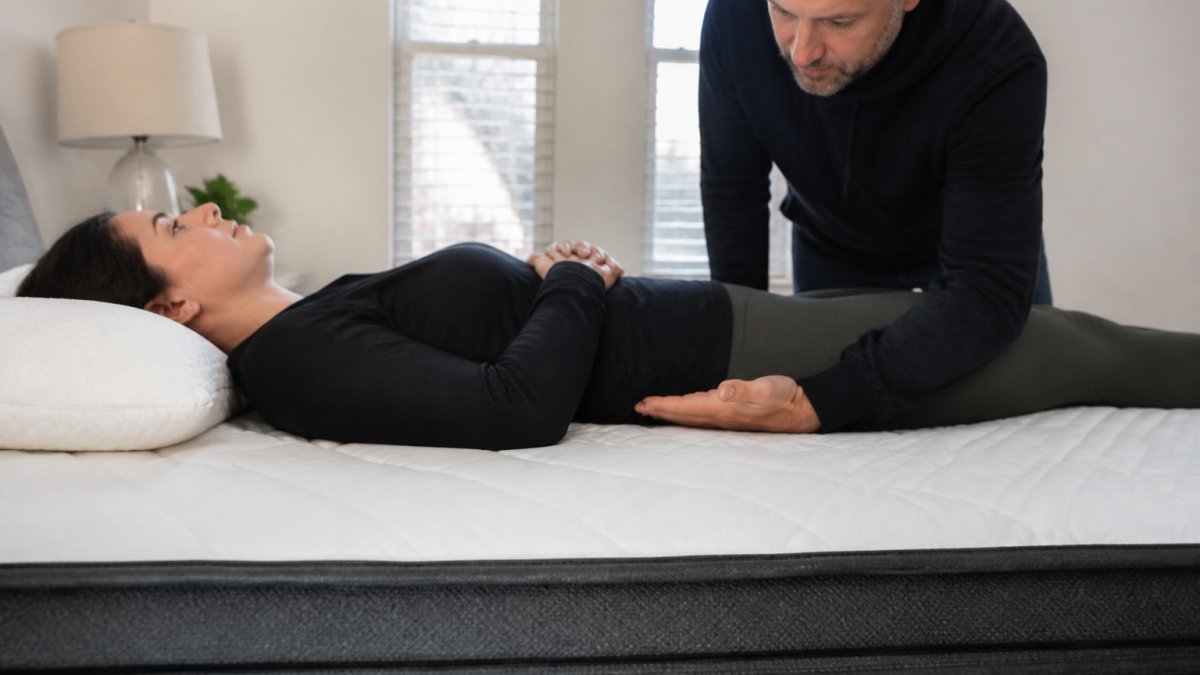
These are starting ranges, not prescriptions. The only reliable test is to lie on the bed in your normal sleep position for at least 15 minutes and slide a hand under your lower back: if you can push your hand through easily, the bed is too soft for your weight; if there is no gap at all and your shoulders or hips ache, it is too firm.
Body Shape Matters as Much as Body Weight
Two people at the same weight can need different firmness because weight distribution differs. A person who carries weight in the hips and thighs puts more load on the lower half of the bed and tends to sink at the pelvis first, the exact failure mode that arches the lower back. A person with a broader shoulder-to-hip ratio needs more give in the upper comfort layer so the shoulders can sink without levering the spine.
That is why zoned support earns its place in a hybrid: firmer coils under the lumbar area and softer coils near the shoulders compensate for shape differences that a uniform firmness rating cannot. If you are still narrowing it down, our guide on how to choose a mattress for back pain walks through the decision step by step.
| Sleeper Type | Firmness Target | What to Watch |
|---|---|---|
| Back sleeper, average weight | Medium-firm (6-7) | Midsection sinkage |
| Side sleeper | Medium (5-6) | Shoulder pressure |
| Stomach sleeper | Firm (7-8) | Hip arching |
| Higher body weight | Firm (7-8) | Support core thickness and coil gauge |
| Lower body weight | Medium (5-6) | Excess pushback |
| Hip-weighted shape | Medium-firm with zoned lumbar support | Pelvis sinkage |
| Broad shoulders | Medium with a soft upper comfort layer | Shoulder pressure and spinal twist |
Shop by your body, not by the label. Bring your own weight and sleep position to the store, lie on the bed for 15 minutes in that position, and judge the gap under your lower back, not how the bed feels under your hand.
Hybrid Mattress Pros and Cons: An Honest Breakdown
The honest case for hybrids is durability and airflow. The honest case against is price and motion transfer. Coils keep air moving, so hot sleepers tend to run cooler than on all-foam. The coil core also resists the body impressions that plague soft foam over time.
The trade-offs are real. Once you have weighed those points, our mattress shopping tips for back pain relief help you apply them in the store.
How Often to Replace a Mattress for Back Support
Most mattresses need replacing every seven to ten years, and back support is usually the first thing to go. Sagging under the lumbar area shows up before the surface looks worn. If you wake with stiffness that fades an hour after getting up, the support core is likely the culprit. Rotate the mattress on schedule, use a protective cover, and check the warranty terms before you assume a replacement is covered.
Durability, Adjustable Bases, and the Details That Decide
Durability is where a hybrid’s back support is won or lost, and it comes down to three measurable things: coil gauge, foam density, and how well the comfort layer resists compression. Coil gauge is the thickness of the wire, a lower number means thicker wire and firmer, more durable support. Foam density is measured in pounds per cubic foot (PCF); a comfort layer under about 2.5 PCF is likely to soften and develop body impressions faster than a denser foam. A thicker support core holds up better for heavier sleepers, which is why a bed that feels supportive in month one can feel hollow under the lumbar area by year four.
What Actually Happens to Support Over Time
Support retention is the part of durability that matters most for back pain, and it is the part most product pages ignore. The common failure pattern is not a collapsed coil, it is the comfort foam above the coils compressing permanently, which lets the hips sink closer to the coil layer and removes the cushioning that kept the pelvis level.
A few practical checks before you buy:
- Coil count and gauge: more coils at a heavier gauge generally mean more consistent pushback under the midsection; ask for the coil count in the queen size, since counts are often quoted for a king.
- Foam density: ask for the PCF of the comfort layers, not just the support core. Denser foam resists compression longer.
- Edge support: a reinforced perimeter keeps the sleep surface from rolling off at the edges, which matters if you sit on the edge or sleep near it.
A warranty is not a durability guarantee. Read the body-impression threshold and the foundation requirements before you buy, because a bed used on the wrong base can void coverage even if the coils fail.
Adjustable Bases and Alignment
Adjustable bases are worth considering if you want to raise the head for reflux or reading, but confirm the bed is compatible first.
Base choice also affects alignment even when you never adjust it. A slatted foundation with gaps wider than about 3 inches, or a box spring that flexes, can let the mattress sag between supports and undermine the coil layer’s pushback.
Break-In, Rotation, and Troubleshooting Uneven Support
New hybrids need a break-in period, typically a few weeks, during which the comfort foam softens slightly and the bed reaches its settled feel. Rotate the mattress on the schedule the manufacturer specifies, many hybrids are not designed to be flipped, only rotated head-to-foot, and use a protective cover to keep the warranty intact. If you notice uneven support, check the foundation first: a sagging or flexing base is a more common culprit than a defective mattress, and it is the first thing a warranty claim will ask about.
How We Test Hybrid Mattresses for Back Support
We test for spinal alignment, pressure distribution, and how the bed holds up over time. Our process is repeatable: lie in each sleep position, check for gap under the lower back, note sinkage at the hips, and rate edge support and motion isolation. You can browse the tested beds in our hybrid and innerspring reviews to see the evidence behind each pick.
Compare Hybrid Mattresses and Claim Your Coupon Code
Comparing hybrids side by side is the fastest way to choose. Match the support core to your body weight, the comfort layer to your sleep position, and the warranty to how long you plan to keep the bed. Ready to act? Our top picks page and coupon codes let you compare current models and save on the one that fits.
Frequently Asked Questions
What kind of hybrid mattress is best for someone with back problems?
Look for a hybrid with a medium-firm feel and a support core of pocketed coils under a comfort layer of memory foam or latex. Coils provide responsive support and keep your hips from sinking too deep, while foam cushions pressure points. Zoned support, where the middle third of the mattress is firmer, helps keep your midsection lifted. Body weight matters: lighter sleepers often do better on the softer end of medium-firm, while heavier sleepers need more coil support to prevent sagging.
What mattress firmness is best for back support?
Medium-firm, roughly a 6 to 7 out of 10, is the most common recommendation for back support. It keeps your spine in a neutral line without creating pressure at the shoulders and hips. Back sleepers usually do well at a 6 to 7, side sleepers often prefer a 5 to 6 for shoulder and hip cushioning, and stomach sleepers need a firmer 7 to 8 to keep the midsection from dipping. Your body weight shifts the effective firmness, so test in person when you can.
How often should you replace a hybrid mattress?
Most hybrid mattresses last seven to ten years, though coil quality and foam density affect that range. Replace sooner if you notice visible sagging, waking with back stiffness that fades during the day, or a mattress that feels less supportive than it did a year ago. Higher-density foams and thicker coil gauges retain support longer. Rotating the mattress every six months helps distribute wear and extends usable life.
What are the downsides of a hybrid mattress?
Hybrids typically cost more than all-foam models, weigh more, and may need a sturdier foundation or adjustable base. Some coil systems transfer motion more than dense foam, which matters for couples. Edge support varies widely by model, so check reviews if you sit on the edge. Foam layers can still trap heat unless the design includes breathable covers or gel infusions. None of these are dealbreakers, but they are worth weighing against the support benefits.
Finding a bed that supports your back without wrecking your budget takes legwork, and that is where we come in. Real Mattress Reviews pairs nearly a decade of store ownership with over 300 video reviews, exclusive coupon codes, and plain answers to the questions shoppers actually ask. Get started with Real Mattress Reviews and find the hybrid that supports your back and your wallet.


Leave a Reply
Want to join the discussion?Feel free to contribute!