
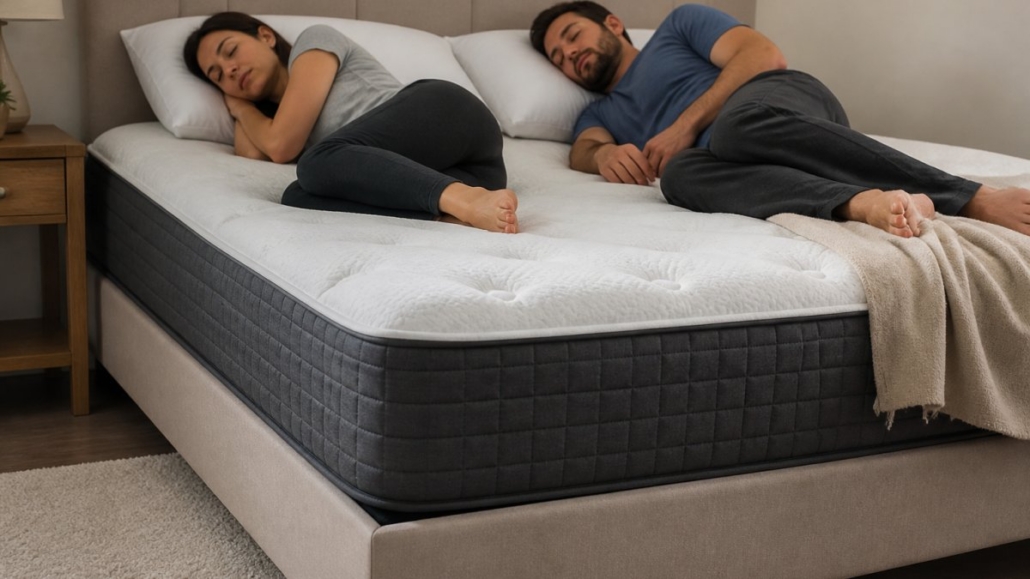
Best Mattress for Couples With Different Needs (2026)
Last Updated: October 23, 2026
Quick Summary
The best mattress for couples with different needs matches each sleeper individually rather than averaging both, so prioritize strong motion isolation, a split-firmness or dual-comfort option, and a sleep trial long enough to test both sides. A firmness gap of three or more points on a 1-to-10 scale calls for a split king, while a one- to two-point gap is usually bridgeable with a medium-firm mattress plus a topper.
- Rate each partner on the same 1-to-10 firmness scale before you shop for a shared bed.
- Choose a split king when the firmness gap is three or more points.
- Test motion transfer by having one partner shift while the other lies still.
- Most warranties only cover visible sagging beyond roughly an inch to an inch and a half.
- Confirm the mattress works with an adjustable base before buying a split setup.
Table of Contents
- Best Mattress for Couples With Different Needs: Quick Comparison
- How We Test Mattresses for Two Sleepers
- Best Mattress for Couples With Different Firmness Preferences
- Best Mattress for Different Sleeping Positions
- Split King Mattress for Couples: When Two Halves Beat One
- Mattress for Couples With Different Temperature Preferences
- Motion Isolation, Edge Support, and Long-Term Durability for Two
- Trials, Returns, and Warranty: The Real Cost of Getting It Wrong
- Frequently Asked Questions
Best Mattress for Couples With Different Needs: Quick Comparison
Finding the best mattress for couples with different needs comes down to one principle: match each sleeper individually, not the average of both.
The quick answer: prioritize a mattress with strong motion isolation, a split-firmness or dual-comfort option, and a sleep trial long enough to test both sides. Below is a side-by-side of the configurations we see work most often for two sleepers.
| Setup | Best For | Firmness Flexibility | Motion Isolation | Watch Out For |
|---|---|---|---|---|
| Split king (two twin XL) | Very different firmness needs | Highest | High | Gap in the middle, two bases |
| Hybrid with zoned support | Mixed sleep positions | Moderate | High | Not truly split |
| Dual-comfort foam | Cooling + comfort mismatch | Moderate to high | High | Limited edge support |
| Adjustable air | Changing needs over time | Highest | Moderate | Higher upfront cost |
How We Test Mattresses for Two Sleepers
We test every mattress the way two people actually share one: two bodies, two sleep styles, and two sets of preferences on the same surface. A single-sleeper test tells you almost nothing about partner disturbance or split-firmness feel.
Our couple-specific testing methodology covers five checkpoints:
- Motion transfer test: one tester shifts and rolls while the other notes disturbance
- Firmness check from both sides, rated independently
- Temperature read after 20 minutes on each side
A mattress can feel perfect solo and fail as a shared surface, the difference shows up in motion isolation and edge support, not showroom bounce.
When you test in-store, bring your partner and lie down in your real sleeping positions for at least ten minutes per side. Testing alone, or sitting instead of lying, hides the exact problems couples run into at home.
Best Mattress for Couples With Different Firmness Preferences
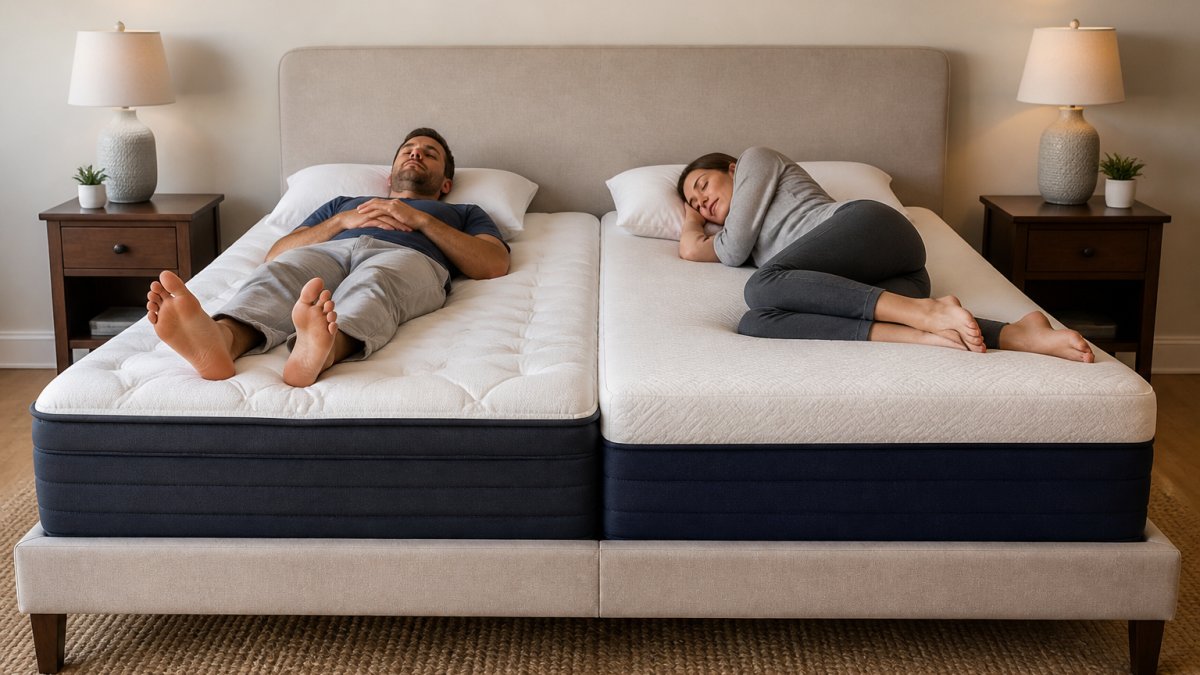
The best mattress for couples with different firmness preferences lets each partner choose their own feel, either through a split-firmness design or a dual-comfort build.
A Decision Framework for Two Different Sleepers
Instead of arguing about which single mattress is “right,” run each partner through the same five inputs.
| Input | What to record for each partner | Why it changes the recommendation |
|---|---|---|
| Body weight | Under 130 lb, 130-230 lb, over 230 lb | Lighter sleepers sink less and often need softer top layers; heavier sleepers compress foam faster and need firmer support cores |
| Sleep position | Side, back, stomach, combination | Side sleepers need shoulder and hip give; stomach sleepers need a flat, firmer surface to keep hips from sinking |
| Temperature | Runs hot, neutral, runs cold | Hot sleepers favor hybrids and breathable covers; a split build keeps one partner’s heat-trapping layers off the other |
| Pain concerns | Shoulder, hip, lower back, none | Shoulder and hip pain point toward pressure relief; lower back pain points toward firmer, zoned support |
| Firmness preference | 1-10 rating from each partner | The size of the gap decides whether a single mattress, a dual-comfort build, or a split king is the honest answer |
A common pattern: a lighter side sleeper rates 3-4 and a heavier back sleeper rates 7-8. That five-point gap is not a topper problem, it is a split-firmness problem. A two-point gap, say 5 and 7, is often solved by a medium-firm hybrid that both partners can live with.
Split-Firmness and Dual-Comfort Configurations
Split-firmness lets each half of the bed carry a different firmness level, solving the firmness-preference problem outright. Dual-comfort designs achieve a similar result within a single mattress by varying the foam layers left to right.
Here is how we would choose between them:
- Split king: pick this when the firmness gap is large (three or more points), one partner wants soft and the other wants firm, or either partner wants independent head and foot positioning on an adjustable base
- Dual-comfort foam: pick this when the gap is moderate (one to two points) and you want one mattress and one foundation
- Adjustable air: pick this when preferences may change over time, one partner has a back condition, or you want to dial firmness in after delivery rather than guess at the store
The trade-off is real: split setups introduce a center gap and often require two bases; dual-comfort builds can feel less refined at the edges; adjustable air beds add a pump and higher upfront cost. Each answers the same question of how much firmness divergence you actually have.
Bring your firmness ratings to the store and lie on each candidate in your dominant sleep position for at least ten minutes per side. If the firmer partner can feel the softer half sagging under them at the center seam, that configuration will not hold up at home.
When Not to Compromise
A medium-feel mattress can absorb small differences in weight and position, but it cannot fix a genuine firmness mismatch. If one partner wakes with shoulder or hip pressure and the other with lower back ache on the same bed, shop for separate firmness zones, a split setup usually costs less than replacing a mattress neither partner likes.
Best Mattress for Different Sleeping Positions
The best mattress for different sleeping positions balances pressure relief for the side sleeper against support for the back or stomach sleeper. Side sleeping concentrates pressure at the shoulder and hip; back and stomach sleeping demand a firmer, more supportive surface.
Combination sleepers need a responsive surface that adapts quickly. Memory foam isolates motion well but can feel slow to move on; hybrids pair foam layers with pocketed coils for better responsiveness without sacrificing pressure relief.
A mattress that is too soft for a stomach sleeper lets the hips sink, which throws the spine out of alignment. If one partner sleeps on their stomach, do not let the softer partner’s preference pull the whole bed toward plush.
Split King Mattress for Couples: When Two Halves Beat One
The case for it is strong when firmness or position needs diverge sharply. The case against it is practical: you feel the seam between the halves, bedding is more involved, and an adjustable base means buying two.
Our rule of thumb: choose split king when the firmness gap would otherwise force one partner into a mattress they dislike. Choose a single mattress when the difference is minor and you value a seamless sleep surface.
Mattress for Couples With Different Temperature Preferences
The best mattress for couples with different temperature preferences uses cooling and breathable materials that manage heat on both sides, since one hot sleeper can warm the shared surface for both partners.
Hot sleepers do better with hybrid and latex builds that move air, while all-foam memory foam can trap heat.
If only one of you overheats, prioritize airflow across the whole mattress rather than a cooling gimmick on one side. The shared surface is what both of you sleep on.
Motion Isolation, Edge Support, and Long-Term Durability for Two
Motion isolation, edge support, and durability matter more for couples because two bodies put double the stress on a shared surface, and these are where a mattress that felt fine solo quietly fails as a shared bed.
How Motion Isolation Actually Works
Motion transfer is a mechanical property, not a marketing claim. Pocketed coils move independently, so a shift on one side compresses only the coils under that sleeper; a continuous innerspring or dense foam core spreads the load across the surface.
Our couple-specific motion test is simple: one tester lies still while the other shifts from back to side to edge and back again. The still partner notes whether they feel a distinct wave, a faint ripple, or nothing.
Edge Support and the Usable Sleep Surface
Edge support decides how much of the mattress is actually usable. Couples who each get up on their own side put repeated load on both edges, and weak edges compress into a ramp that pushes each sleeper toward the center, reducing the effective sleep surface and increasing motion transfer. Test edge support where each partner actually sits and gets up, and note whether the edge holds firm or rolls you inward.
Long-Term Durability for Two Sleepers
Two sleepers mean more weight and more compression cycles, so a mattress that sags early fails couples faster than solo sleepers. Memory foam and hybrid builds with dense support cores tend to hold up, but check the warranty terms. Heavier couples should favor firmer support layers.
A few concrete checks before you buy:
- Support-core density: ask for the foam density in the base layer. Higher-density foam resists compression over time; low-density foam is where early sagging starts.
- Warranty sagging threshold: most warranties only cover visible sagging beyond a stated depth, commonly around an inch to an inch and a half. Measure against that number, not against the marketing claim of a “lifetime” warranty.
- Weight distribution: if one partner is significantly heavier, that side will break down first. A split or dual-comfort build lets you replace or rotate each half independently rather than replacing the whole mattress.
For couples, the three specs that predict long-term satisfaction are motion isolation, edge support, and a support core rated for two sleepers. Firmness gets the attention; these three decide whether you still like the mattress in year five.
Adjustable Bases and Sleep-System Compatibility
If either partner wants independent head and foot positioning, confirm the mattress works with an adjustable base before you buy. Split king setups pair naturally with split adjustable bases, so each partner can raise the head without moving the other; a single king on a single base moves both together. Check the mattress’s compatibility list, the base’s weight rating for two sleepers, and whether a specific foundation is required to keep the warranty valid.
Trials, Returns, and Warranty: The Real Cost of Getting It Wrong
A sleep trial is the only reliable way to know whether a mattress works for both partners, so treat the trial length, return policy, and warranty as part of the price.
Before you buy, confirm four things:
- Trial length: long enough for both partners to test their own side through a full adjustment period
- Return policy: who pays shipping, and whether returns are free or deducted
- Warranty: what sagging depth and defects it covers, and for how long
The Federal Trade Commission’s guidance on buying mattresses is a useful starting point for understanding your rights and what a seller must disclose.
At Real Mattress Reviews, our coupon codes help you save on the purchase, and our video reviews answer the specific questions couples ask before buying.
Two people rarely need the same mattress, and pretending otherwise is how couples end up returning beds. The fix is to match each sleeper’s firmness, position, and temperature needs, then back the choice with a real sleep trial. Real Mattress Reviews can help you get there with nearly a decade of store experience, a library of over 300 video reviews, and exclusive coupon codes that make the right mattress more affordable.
Frequently Asked Questions
What mattress features help couples with different sleep preferences?
Look for three things: adjustable or split-firmness construction, strong motion isolation from pocketed coils or dense foam, and cooling layers if either partner runs hot. A medium-firm hybrid usually balances support and pressure relief for mixed sleep styles. If firmness needs differ sharply, a split king with two separate comfort levels solves the problem outright rather than forcing a compromise. Always check the sleep trial length before committing, since 90 to 120 nights is common and lets both partners test the mattress for a mattress for couples in real conditions.
Are split-firmness mattresses a good choice for couples?
Yes, when partners genuinely need different firmness levels. A split king mattress for couples lets each side carry its own comfort layer, so a side sleeper who needs pressure relief and a back sleeper who needs support both get what they want. The tradeoffs: you lose the shared middle surface, bedding costs more, and some adjustable bases are required to get the full benefit. If your firmness gap is small, a single medium-firm hybrid is simpler and cheaper. If one partner wakes up sore every morning, split firmness is worth the extra spend.
How can couples reduce motion transfer when one partner moves during the night?
Pocketed coil systems and dense memory foam both limit motion transfer, and hybrids that combine them tend to perform best. A mattress with individually wrapped coils isolates movement better than traditional innerspring. Also consider a split king setup, where each half moves independently, and a sturdy adjustable base that absorbs movement. If a partner tosses frequently, test the mattress in-store by having one person roll over while the other stays still, and prioritize motion isolation over plushness when comparing options.
Does a heavier person need a firmer mattress?
Often, yes. Higher body weight compresses comfort layers more, so a mattress that feels medium to a lighter sleeper can feel soft and unsupportive to a heavier one. Heavier sleepers typically do better with firmer support cores, thicker coils, and higher-density foams that resist sagging. For couples with a significant weight difference, split firmness or a medium-firm hybrid with a strong support layer usually works better than a single plush mattress. Check the warranty’s weight limits and sagging clauses before buying.


Leave a Reply
Want to join the discussion?Feel free to contribute!