
Mattress Shopping Tips for Back Pain Relief
Table of Contents
- Start With Your Sleep Position, Not the Label
- Mattress Firmness for Back Pain: Finding Your Range
- Why a Hybrid Mattress for Back Pain Often Balances Support and Pressure Relief
- Signs of a Bad Mattress You Should Not Ignore
- A Practical Mattress Testing Checklist for Store and Online
- Read the Mattress Trial Period, Warranty, and Return Costs Before You Pay
- Mattress Shopping Tips for Back Pain Relief: Body Weight, Couples, and Sleep System Adjustments
- Conclusion
- Frequently Asked Questions
Last Updated: October 19, 2026
Start With Your Sleep Position, Not the Label
Most people walk into a showroom and ask for “medium-firm.” That is the wrong first question, and it is why so many shoppers end up with a mattress that fights their body instead of supporting it.
Your sleep position determines where your spine needs support. Back sleepers need a surface that keeps the lumbar curve supported without letting the hips sink. The sleep position guidance from the Cleveland Clinic is a useful starting reference for how posture affects spinal load overnight.
At Real Mattress Reviews, we have spent nearly a decade watching customers test mattresses in stores, and the pattern is consistent: people who buy for a label rather than a position come back unhappy.
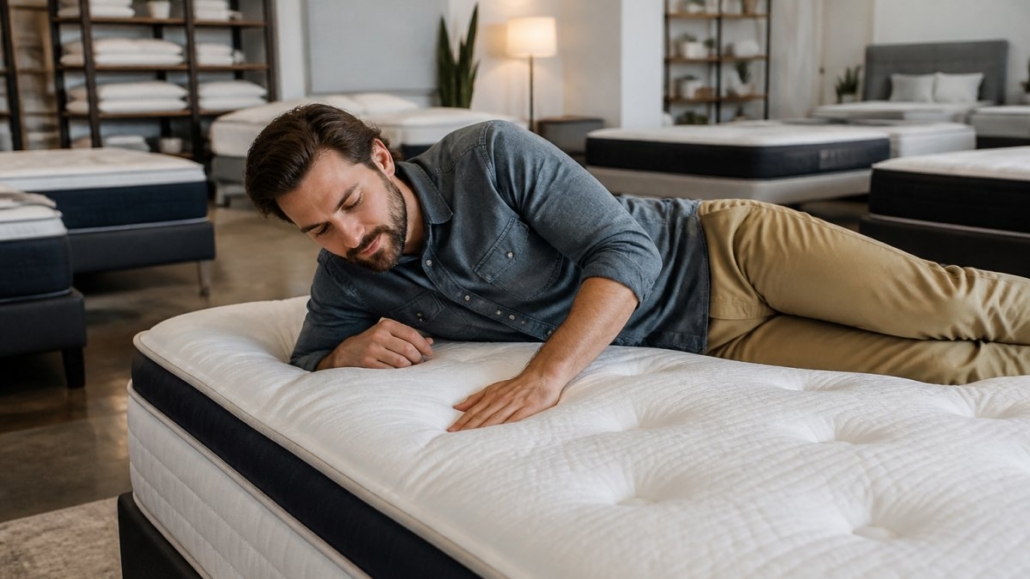
Lie on a candidate mattress in your dominant sleep position for at least ten minutes. Most shoppers test on their back for thirty seconds, which tells you almost nothing about how the bed performs at 2 a.m.
Mattress Firmness for Back Pain: Finding Your Range
Mattress firmness for back pain is not a single number. For most back sleepers, a medium-firm surface works because it supports the lumbar region without creating pressure points. Side sleepers usually need something softer to prevent shoulder and hip pain.
The mistake is treating firmness as a virtue. A mattress that is too firm creates pressure points and muscle strain; too soft and the lower back sags into extension, which many people describe as morning stiffness.
| Sleep Position | Firmness Range | What to Watch For |
|---|---|---|
| Back | Medium-firm | Lumbar support without hip pressure |
| Side | Medium to medium-soft | Shoulder and hip cushioning |
| Stomach | Firm | Lower-back sagging |
| Combination | Medium | Motion isolation and edge support |
Why a Hybrid Mattress for Back Pain Often Balances Support and Pressure Relief
A hybrid mattress for back pain pairs a coil support core with foam or latex comfort layers. That combination matters because it solves the tension most shoppers feel: coils give pushback and durability, while the comfort layer delivers pressure relief.
What most guides miss is that hybrid construction varies enormously. Coil count, gauge, and the transition layer determine whether the bed actually supports your lower back or just feels springy.
Do not judge a hybrid by the first five minutes. Coil-and-foam beds need a break-in period, and a mattress that feels stiff on day one often settles into the right feel after a few weeks.
Signs of a Bad Mattress You Should Not Ignore
The signs of a bad mattress show up in your body before they show up in the showroom. Waking with lower-back pain that eases within an hour of getting up is a classic signal.
Pain that persists all day, radiates down a leg, or comes with weakness or tingling is a different category. That warrants a conversation with a clinician, not a shopping trip.
A Practical Mattress Testing Checklist for Store and Online
Testing a mattress properly takes more than a bounce with your hand. Use the same routine in a store and, as far as possible, with an online trial.
The 20-minute in-store routine
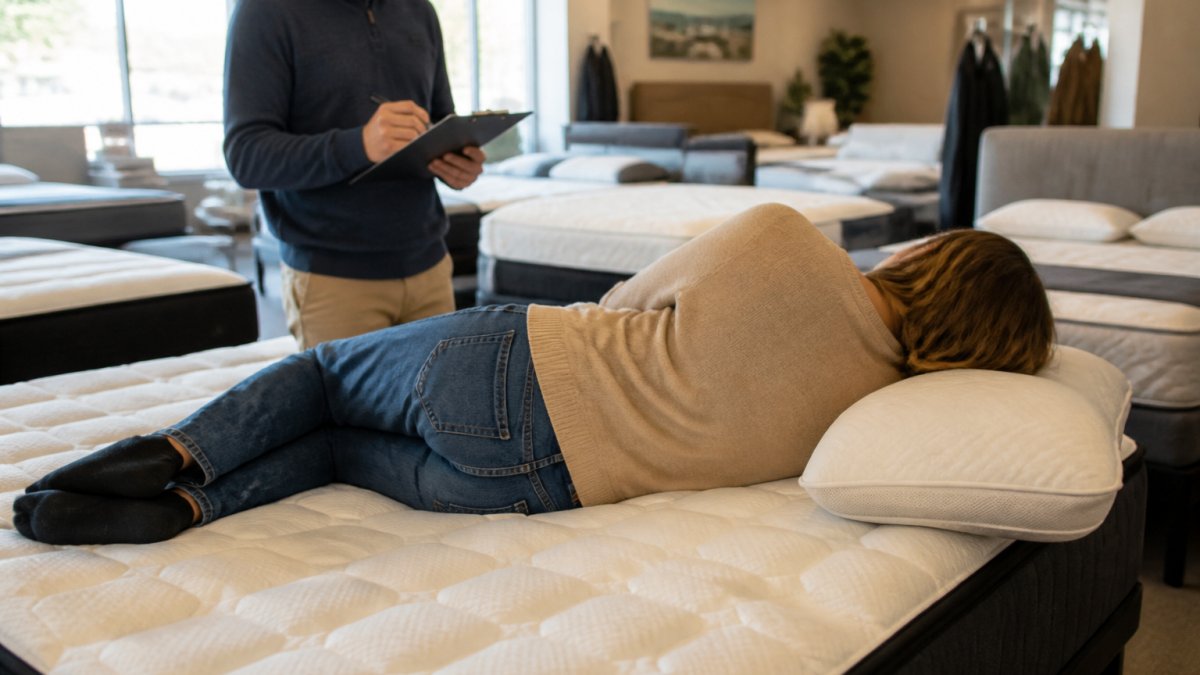
Block out at least 20 minutes per candidate bed. Most shoppers give a mattress 30 seconds on their back, which tells you almost nothing about how it performs at 2 a.m. Run this sequence in order:
- Lie in your dominant sleep position for 10-15 minutes. Set a phone timer. Discomfort that appears at minute eight is the signal you came for.
- Roll from back to side and back again. Note whether your spine stays straight or bows. A partner can sight down your spine from behind; a straight line from ear to shoulder to hip is the target.
- Slide a flat hand under your lower back while on your back. A small gap that your hand fills is fine. A deep gap means the lumbar region is unsupported; a hand you cannot slide in at all means the bed is too soft and your hips are sinking.
- Check shoulder and hip pressure on your side. Pressure should feel spread across the shoulder and hip, not concentrated in a hot spot. Numbness or tingling in the arm is a fail.
- Sit on the edge. Edge support matters for getting in and out and for couples who sleep near the perimeter. A collapsing edge signals weak perimeter construction.
- Have a partner move while you lie still. This gauges motion isolation, which matters more for couples and combination sleepers.
- Note temperature. Lie still for a few minutes and notice whether the surface traps heat. Memory foam and some hybrid comfort layers sleep warmer than latex or coil-forward designs.
- Ask the questions below before you leave the store.
Questions to ask before purchase
- What is the trial period, and does it start on delivery or on the first night of sleep?
- Is there a minimum break-in period before I can return?
- Who pays return shipping, and is there a restocking fee?
- Is the refund a full refund or an exchange credit?
Adapting the routine for online purchases
Online, you cannot lie down, so lean on the trial period and the return policy as your test drive. Before you order:
- Confirm the trial length and the return-fee structure in writing, not just on the product page.
- Check whether the trial applies to the mattress only or also to a foundation, base, or bundle.
- Read the warranty exclusions for sagging thresholds and normal softening.
- Keep the original packaging if the return policy requires it.
- Photograph the mattress and foundation on delivery day in case of a damage claim.
Bring a friend or partner to the store. A second set of eyes on your spinal alignment and a second opinion on pressure points catches what you cannot feel yourself.
Read the Mattress Trial Period, Warranty, and Return Costs Before You Pay
A mattress trial period is only as good as its fine print. Two beds can both advertise a “100-night trial” and offer very different protection. The details that decide whether you are actually covered are the same across brands, so compare every candidate on these points before you pay.
Compare trials on these terms
- Trial length and start date. Confirm whether the clock starts on the order date, the delivery date, or the first night of sleep. A trial that starts at order can lose a week or more to shipping.
- Minimum break-in period. Many trials require you to sleep on the bed for a set number of nights before you can return it. That is reasonable for foam and hybrid beds that need to settle, but it means you cannot bail on night two.
- Return shipping and restocking fees. Some brands cover return shipping; others deduct it from your refund. Restocking fees, when they apply, reduce the refund further. Ask for the exact dollar amount before you buy.
- Refund versus exchange. A full refund and an exchange credit are not the same thing. If you want the option to walk away, prioritize a refund policy.
- What the trial covers. Confirm whether the trial applies to the mattress only or also to a foundation, adjustable base, or bundle. Returning the mattress but keeping a non-returnable base can leave you with a sunk cost.
Read the warranty for what it actually covers
The FTC’s guidance on warranties and guarantees is worth reading before you rely on a “lifetime warranty” claim. Warranties typically cover manufacturing defects like sagging beyond a stated threshold, not normal softening or a change in comfort preference. Look for:
- The sagging threshold. A warranty that covers sagging beyond three-quarters of an inch is stronger than one that requires a full inch or more.
- What voids coverage. Stains, improper foundation use, and removing the law tag are common voiding conditions. A mattress protector is cheap insurance.
- Prorated versus full coverage. Some warranties replace the mattress outright for a set period, then prorate the credit. Know which years are which.
- Who pays shipping on a warranty claim. A “free replacement” that costs a few hundred dollars to ship is not free.
Account for delivery, setup, and hidden costs
The sticker price is not the out-the-door price. Add up delivery fees, old-mattress removal, setup, and foundation or base costs before you compare beds. A bed that is a little more expensive but includes free delivery and removal can be the cheaper choice. Ask whether delivery is threshold, room-of-choice, or white-glove setup, because the difference affects both cost and convenience.
The trial period, return costs, and warranty terms matter as much as the mattress itself. A bed you can actually return beats a bed you are stuck with. Write down the trial length, return fee, and sagging threshold for every candidate before you decide.
Mattress Shopping Tips for Back Pain Relief: Body Weight, Couples, and Sleep System Adjustments
Body weight and body shape change what “supportive” means.
The sleep system matters too. An adjustable base can raise the head or feet to reduce pressure and support the lower back.
This is where our video library helps. Real Mattress Reviews has built over 300 video reviews so you can compare how different beds handle back pain, hot sleeping, and couples with different preferences before you commit.
Conclusion
Finding a mattress that actually helps your back takes more than chasing a firmness label. It takes matching the bed to your sleep position, testing it properly, and reading the trial and warranty terms before you pay.
At Real Mattress Reviews, we built our library of over 300 video reviews and our decade of store ownership experience to make that decision easier.
Frequently Asked Questions
Is a hybrid mattress good for back pain?
A hybrid mattress for back pain can work well because it pairs a coil support core with a foam or latex comfort layer. The coils push back against the lower back while the top layer cushions pressure points at the hips and shoulders. That combination suits side sleepers and people who want support without a rock-hard surface. It is not automatically better than other types, so test one in person or use a trial period before committing.
What are the signs of a bad mattress?
Common signs of a bad mattress include visible sagging in the middle, waking with morning stiffness that fades during the day, rolling toward the center, and springs you can feel through the surface. A mattress that is more than seven to ten years old and no longer holds its shape is a strong candidate for replacement. If pain patterns follow the mattress rather than your activity, that is another signal to shop.
What mattress firmness is best for back pain?
Medium-firm is the most common starting point for mattress firmness for back pain, because it keeps the spine close to neutral while still cushioning the hips and shoulders. Back sleepers usually do well at medium-firm, side sleepers often prefer slightly softer, and stomach sleepers need firmer support to keep the lower back from dipping. Use medium-firm as a starting range, then adjust based on your body weight and sleep position.
How long should I try a new mattress before deciding if it helps?
Plan on at least 30 nights. Most mattress trial period policies run 90 to 120 nights, and your body needs several weeks to adjust to a new sleep surface. Keep a simple log of morning stiffness and pain levels for the first month. If pain is getting worse rather than better after three to four weeks, contact the retailer about a return or exchange before the window closes.
How do I know if my mattress is causing back pain?
Track when the pain appears. If lower-back pain is worst in the morning and eases after you get up and move, the mattress is a likely contributor. Pain that follows a new mattress purchase, or that started when the mattress began sagging, points the same way. Pain that worsens through the day or comes with numbness, weakness, or radiating leg pain deserves a medical evaluation rather than a shopping trip.
Which mattress should I buy for back pain?
There is no single answer, but the practical path is to match the mattress type to your sleep position and body weight. Hybrids and latex models suit people who want support plus pressure relief, while all-foam models can work for lighter side sleepers. Test for neutral spinal alignment, check the trial period and return costs, and avoid buying on firmness labels alone. A mattress that keeps your spine neutral is the one to buy.


Leave a Reply
Want to join the discussion?Feel free to contribute!