How to Compare Mattress Construction Materials in 2026
Last Updated: November 5, 2026
Quick Summary
To compare mattress construction, read the layers instead of the marketing names: check the support core, transition layer, and comfort layer, then line up the same specs for every candidate, namely core type, foam density, coil gauge, and cover construction. A zippered cover lets you verify those specs, while a sewn-shut cover hides them.
- Every mattress stacks a support core, a transition layer, and a comfort layer under a cover.
- Higher-density memory foam generally holds up longer than low-density foam.
- A lower coil gauge number means thicker wire and a firmer, more durable spring.
- Foam density is measured in pounds per cubic foot and predicts sagging resistance.
- Build a table with identical rows per candidate and mark unpublished specs as unknown.
Table of Contents
- Mattress Construction Layers Explained
- Memory Foam vs Latex Mattress: Reading the Specs That Matter
- Hybrid vs Foam Mattress: Coil Systems and Support Cores
- Mattress Materials for Hot Sleepers: Breathability and Temperature Regulation
- Material Quality by the Numbers: Foam Density and Coil Gauge
- Certifications, Chemical Disclosures, and Sourcing to Check
- How Construction Affects Warranty, Repairability, and End of Life
- Compare Mattress Construction Side by Side Before You Buy
- Frequently Asked Questions
Mattress Construction Layers Explained
Learning how to compare mattress construction materials starts with one rule: ignore the marketing names and read the layers. Every mattress is a stack of three functional zones, each with a specific job.
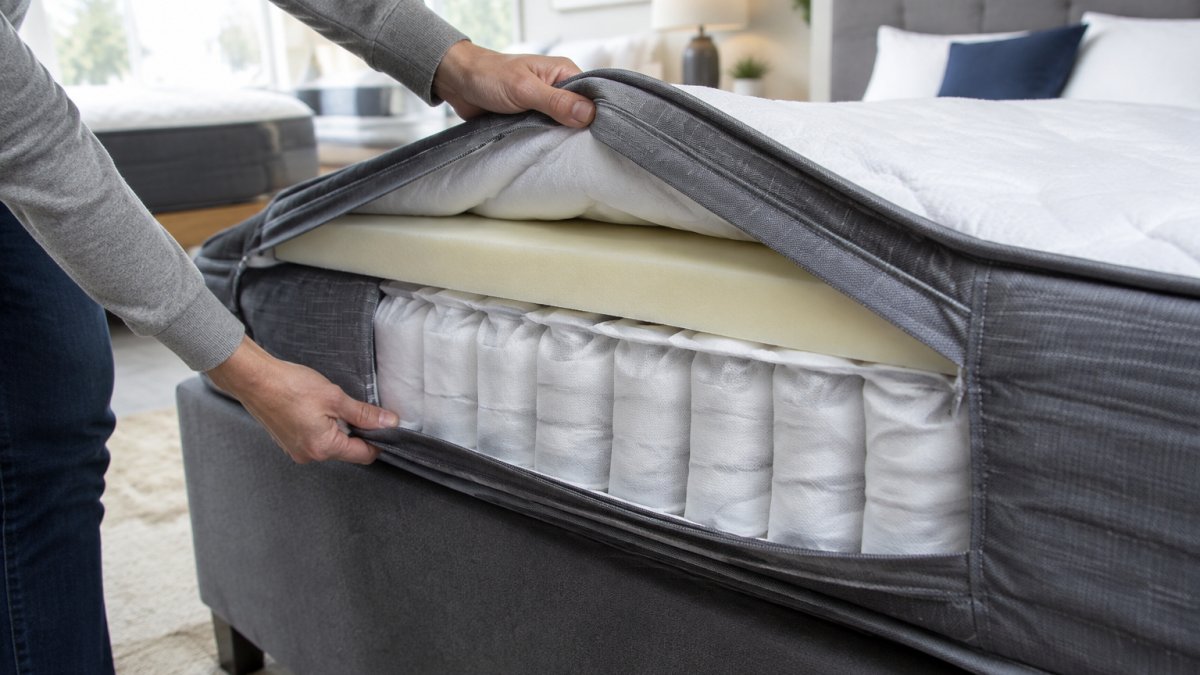
Mattress construction is the arrangement of a support core, a transition layer, and a comfort layer, wrapped in a cover that determines how much of that stack you can actually inspect.
The Support Core, Transition Layer, and Comfort Layer
The support core carries your body weight and sets the baseline feel. Innerspring cores use steel coils; foam cores use dense polyfoam or latex. The transition layer sits above the core and bridges the gap between deep support and surface softness.
A common mistake is judging a mattress by its comfort layer alone. A plush top over a weak core sags fast, no matter how good the first night feels.
What the Mattress Cover Hides
The mattress cover is where specifications go to disappear. Many covers are sewn shut, so you cannot verify foam density, coil gauge, or layer thickness without cutting the bed open. Zippered covers let you inspect the stack directly. If a brand won’t publish layer thicknesses and material types, treat that as a data point in itself.
Memory Foam vs Latex Mattress: Reading the Specs That Matter
Memory foam and latex both contour to the body, but they behave differently and the specs prove it. Memory foam is a viscoelastic polyfoam that softens with body heat and slowly recovers its shape. Latex foam is resilient and springs back immediately, and it comes in natural, synthetic, and blended forms.
For the memory foam vs latex mattress decision, check three numbers: foam density, layer thickness, and whether the latex is natural, synthetic, or blended. Higher-density memory foam generally holds up longer than low-density foam, while latex tends to sleep cooler and bounce more. To see how latex specs look in practice, browse the latex mattress reviews we’ve put together.
Hybrid vs Foam Mattress: Coil Systems and Support Cores
A hybrid mattress pairs a coil system with foam comfort layers; a foam mattress uses an all-foam support core. That single difference drives most of the hybrid vs foam mattress trade-off: hybrids generally offer more bounce, airflow, and edge support, while all-foam beds tend to isolate motion better.
Open-Coil and Pocket Spring Designs Compared
Open-coil systems link the springs together, so movement travels across the bed. Pocket spring designs wrap each coil individually, which improves motion isolation and lets the coils respond to weight independently. Coil gauge matters too: a lower gauge number means thicker wire and a firmer, more durable spring. Coil count sounds impressive in marketing, but gauge and coil diameter usually tell you more about how the system will hold up. Our hybrid and innerspring mattress archive collects the models we’ve reviewed.
Mattress Materials for Hot Sleepers: Breathability and Temperature Regulation
Temperature regulation comes down to airflow and heat retention. Memory foam traps heat because it softens against your body; latex and pocket coil systems generally move air more freely.
For hot sleepers, prioritize open coil cores, latex or gel-infused foams, and covers described as breathable rather than simply soft. Our cooling mattress picks go deeper on which builds actually sleep cool.
Material Quality by the Numbers: Foam Density and Coil Gauge
Two specifications do most of the durability work: foam density and coil gauge. Neither is a guarantee, but both are far more useful than a layer count or a marketing name. The trick is knowing what the numbers mean and where each spec stops telling you anything. Foam density is most useful when considered alongside how the foam is made, since professional foam durability depends on more than a number on a spec sheet.
Foam Density: Pounds per Cubic Foot
Foam density is weight per unit volume, expressed in pounds per cubic foot (lb/ft³). It is not the same as firmness: a dense foam can be soft, and a low-density foam can be firm.
Density is typically reported in pounds per cubic foot (lb/ft³), and it is most useful when compared within the same foam type.
Density has limits. It says nothing about airflow, heat retention, or how a foam feels.
Coil Gauge and Coil Count
Coil gauge describes wire thickness, and the numbering runs opposite to intuition: a lower gauge number means thicker wire.
Coil count is the number buyers fixate on, and it is the least useful number on the sheet by itself.
Watch out: a brand that advertises a high coil count while omitting gauge and coil diameter is giving you a number that cannot be compared across products.
The Specs That Are Usually Missing
A complete spec sheet also states layer thicknesses in inches, the order of layers, and the cover material.
A practical comparison method is to build a small table for each candidate with the same rows: core type, core density or coil gauge, transition layer material and thickness, comfort layer material, density, and thickness, cover type (zippered or sewn), and any third-party certifications.
For a sense of how these specs play out in finished products, our latex mattress reviews and hybrid and innerspring mattress archive list the layer and coil details we were able to verify.
Certifications, Chemical Disclosures, and Sourcing to Check
Certifications are useful, but only if you know what each one actually verifies. A logo on a product page is not a performance claim. It usually confirms one of three things: that emissions were tested, that a material content claim was verified, or that a manufacturing facility met a standard. Treat each label as answering a narrow question, not as a guarantee that the mattress is comfortable, durable, or free of every chemical of concern.
What Common Certifications Actually Verify
- Material content and fiber claims: CertiPUR-US is a foam certification that covers content restrictions (such as excluding certain heavy metals and phthalates), emissions limits, and durability testing for flexible polyurethane foam (About Certified Foam). It applies to foam, not to the whole mattress, so a CertiPUR-US logo tells you nothing about the coils, cover, or adhesives.
- Textile safety: OEKO-TEX Standard 100 tests finished textiles, including covers and fabrics, for harmful substances (OEKO-TEX® STANDARD 100). It is relevant to the cover and any fabric layers, not the core.
- Federal requirements: Mattresses sold in the United States must meet the federal flammability standard at 16 CFR Part 1633, which is a legal requirement rather than a voluntary certification. The Consumer Product Safety Commission publishes recall and safety information worth checking before any large purchase.
Reading Chemical Disclosures Without Overreading Them
A certification answers a defined question. It does not tell you the full chemical inventory of a mattress.
Natural versus synthetic content is another place labels get stretched. Latex may be natural, synthetic (styrene-butadiene rubber), or blended, and the spec sheet should say which.
Watch out: treat a missing disclosure as information. If a brand cannot tell you the foam type, the latex type, or the country of manufacture, that silence is a data point in your comparison, not a neutral gap.
Sourcing Questions Worth Asking
Ask where the foam is poured, where the latex is tapped and processed, and where final assembly happens. These are commonly separate locations, and a brand that can answer clearly is usually a brand that can also answer spec-sheet questions. For sensitive sleepers, pair the certification check with the density and thickness numbers covered above, because emissions testing and durability testing answer different questions.
How Construction Affects Warranty, Repairability, and End of Life
Construction determines how long a mattress lasts and what happens when it fails. Dense foams and thick-gauge coils generally hold up longer, and a zippered cover makes it possible to replace a worn comfort layer instead of the whole bed.
End of life is the overlooked part. If longevity is your priority, our roundup of the most durable mattresses shows which builds hold up best.
| Construction Element | What to Check | Why It Matters |
|---|---|---|
| Support core | Coil gauge or foam density | Drives durability and baseline firmness |
| Transition layer | Thickness and material | Balances support with pressure relief |
| Comfort layer | Foam type and density | Controls feel, heat, and contouring |
| Cover | Zippered vs sewn shut | Determines whether specs are verifiable |
| Certifications | Third-party listings | Confirms chemical and material disclosures |
Compare Mattress Construction Side by Side Before You Buy
Side-by-side comparison works best when you line up the same four specs for every candidate: core type, foam density, coil gauge, and cover construction. Put them in a table, and the marketing language falls away fast. A mattress with a dense core and a verifiable spec sheet generally deserves more confidence than one with a clever name and no numbers.
Before you trust any spec sheet, it helps to know why reviews and claims can mislead. Our guide on why mattress reviews are often unreliable explains what to watch for, so your side-by-side comparison rests on facts rather than hype.
| If your priority is… | Look for… | Watch out for… |
|---|---|---|
| Cooling | Pocket coils, latex, breathable covers | Dense memory foam with no airflow |
| Back support | Dense core, medium transition layer | Soft tops over weak cores |
| Durability | High foam density, thick coil gauge | Hidden specs and sewn covers |
| Couples | Independent coil response | Linked open-coil systems |
Frequently Asked Questions
What materials are used to make a mattress?
Most mattresses combine three or four material groups. Polyfoam and memory foam form the comfort layer, latex foam (natural, synthetic, or blended) offers a springier feel, and steel coils or a high-density foam base make up the support core. A transition layer sits between them, and the mattress cover is usually a knit or woven fabric. Reading the layer composition tells you more about how a mattress will feel than the marketing name on the box.
What is the difference between memory foam and latex mattresses?
Memory foam softens with body heat and contours closely, which helps with pressure relief but can sleep warm and slow movement. Latex foam responds faster, feels bouncier, and generally sleeps cooler because of its open-cell structure. In a memory foam vs latex mattress comparison, check foam density on the memory foam side and whether the latex is natural, synthetic, or blended. Sleep position and body weight decide which feel works better for you.
Are hybrid mattresses better than all-foam mattresses?
Neither is universally better. A hybrid vs foam mattress decision comes down to support style and edge support. Hybrids pair a coil system with foam layers, giving more bounce, airflow, and firmer edges, which suits couples and hot sleepers. All-foam models isolate motion better and often cost less. Compare coil gauge, coil count, and foam density in the comfort layer rather than assuming one category wins.
Which mattress materials sleep coolest?
Latex foam, pocket spring coil systems, and breathable covers tend to sleep cooler than dense memory foam. For mattress materials for hot sleepers, look at airflow through the support core, open-cell or gel-infused foams, and whether the cover is a breathable knit. A thick, tightly quilted cover can trap heat even over a cooling layer. Pairing a breathable mattress with moisture-wicking bedding matters as much as the foam itself.
How can you tell if a mattress uses high-quality foam?
Foam density is the clearest signal. Higher-density foam in support layers generally holds its shape longer than low-density foam. Ask for the density of each foam layer, not just the top one. Low-density polyfoam in the support core is a common cause of sagging within a few years, even when the mattress feels fine in the store.
How do mattress layers affect firmness and support?
Firmness comes mostly from the top comfort layer, while support comes from the core. A thick soft comfort layer feels plush but can let heavier sleepers sink too far; a thinner comfort layer over a firm core feels firmer. The transition layer controls how gradually you sink. When you compare mattress construction, match layer thickness and foam density to your sleep position and body weight rather than relying on the firmness label alone.
Comparing mattress construction materials is the difference between buying a bed and buying a spec sheet you can actually trust. At Real Mattress Reviews, we’ve spent nearly a decade running a mattress store and built a library of over 300 video reviews to help you read the layers, not the labels. Our exclusive coupon codes help you save on the models that pass the test. Get started with Real Mattress Reviews and choose your next mattress with confidence.