
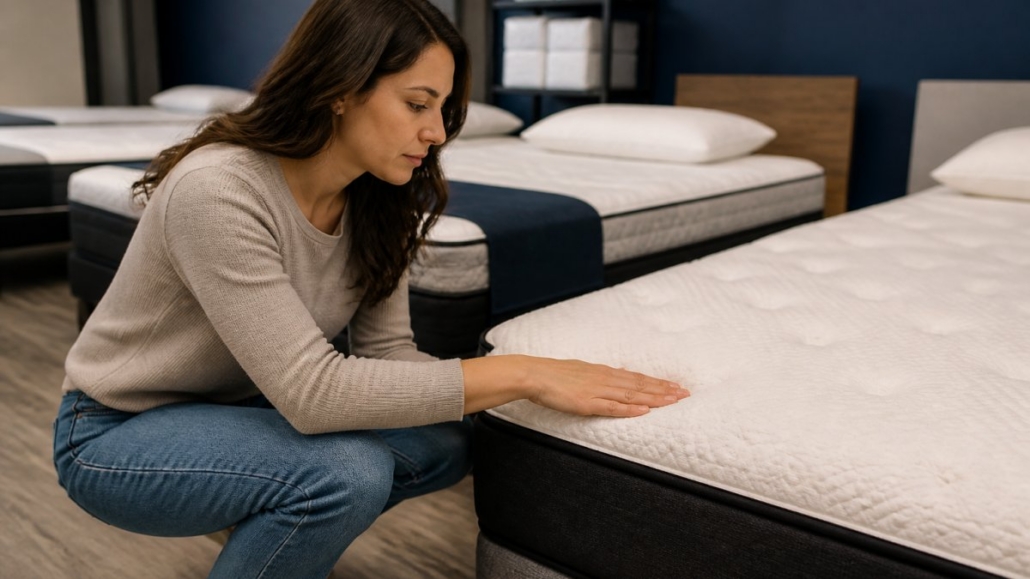
Mattress Firmness Scale Explained for Beginners
Last Updated: October 28, 2026
Quick Summary
Mattress firmness is how soft or hard a mattress feels when you lie on it, rated on a subjective 1-10 scale where 1 is softest and 10 is hardest. Most mattresses sold fall between 4 and 7, and there is no industry standard, so each brand sets its own reference points.
- Firmness is how a mattress feels, while support is how well its layers keep your spine aligned.
- Side sleepers do best around 4-6, back sleepers at 6-7, and stomach sleepers at 7-8.
- Lighter sleepers should lean one step softer than the chart suggests, heavier sleepers one step firmer.
- Lie in your dominant position for 15 minutes and check pressure points and spinal alignment.
- Give a new bed two weeks before you judge it.
Table of Contents
- What Mattress Firmness Actually Means (And Why It’s Not Support)
- How the Mattress Firmness Scale 1-10 Works
- Reading a Mattress Firmness Chart: From Plush to Extra Firm
- The Best Mattress Firmness for Side Sleepers, Back, and Stomach Sleepers
- Mattress Firmness by Body Weight: Why 120 Pounds and 250 Pounds Need Different Feels
- Why Firmness Ratings Vary Between Brands (And How to Test at Home)
- Couples, Hot Sleepers, and Special Cases: When One Firmness Doesn’t Fit All
- Find Your Firmness Before You Buy
- Frequently Asked Questions
What Mattress Firmness Actually Means (And Why It’s Not Support)
Mattress firmness is how soft or hard a mattress feels when you lie on it, while support is how well the layers beneath keep your spine aligned. The two get confused constantly, and that confusion costs people money.
A firm surface with weak support still lets your hips sink out of line. A soft surface with strong support can hold your spine perfectly straight. Feel and function are separate jobs, performed by separate layers.
That distinction is the whole ballgame. Get it right and the rest of the mattress firmness scale makes sense. Get it wrong and you’ll chase a number that never solves your problem.
How the Mattress Firmness Scale 1-10 Works
The mattress firmness scale 1-10 is a subjective rating system where 1 is the softest feel and 10 is the hardest, with most mattresses sold between 4 and 7. There is no industry standard behind it. Each brand sets its own reference points, which is why the same number can feel different from one store to the next.
Think of it as a shared vocabulary rather than a measurement. A 6 from one manufacturer and a 6 from another may sit a full point apart in real life. Use the scale to narrow your shortlist, then let your own body settle the final decision.
Soft, Medium, and Firm: What Each Level Feels Like
- 1-3 (soft to extra soft): Deep sinkage, heavy contouring, a plush pillow-top feel. You lie in the mattress rather than on it.
- 4-6 (medium to medium-firm): A balance of cushioning and pushback. The top layer gives, the core holds. This range suits the widest spread of sleepers.
- 7-8 (firm): Minimal sinkage, a flat, supportive surface with little contouring.
- 9-10 (extra firm): Very little give. Common in latex and dense innerspring builds, and rare in mainstream retail.
Reading a Mattress Firmness Chart: From Plush to Extra Firm
A mattress firmness chart maps those numbers to sleeper needs. Read it as a starting filter, not a verdict. The chart narrows the field; your sleep position and body weight make the final call.
| Scale Rating | Feel | Best For | Watch Out For |
|---|---|---|---|
| 1-3 | Extra soft to soft | Lightweight side sleepers | Stomach sleepers sink out of alignment |
| 4-5 | Medium | Side and combination sleepers | Heavier sleepers may bottom out |
| 6-7 | Medium-firm | Back sleepers, most couples | Side sleepers may feel shoulder pressure |
| 8-10 | Firm to extra firm | Stomach sleepers, heavier sleepers | Lightweight side sleepers lose pressure relief |
The Best Mattress Firmness for Side Sleepers, Back, and Stomach Sleepers
The best mattress firmness for side sleepers sits in the soft-to-medium range, around 4-6, because the shoulder and hip need to sink enough to keep the spine straight. Back sleepers usually do best at 6-7, where the surface holds the lower back without a gap. Stomach sleepers need 7-8 so the hips don’t drop and arch the lower back.
Combination sleepers, who rotate through positions overnight, tend to land at 5-6 as a compromise.
Once you know your range, the next step is matching it to specific models. Our guide to the best mattresses for side sleepers covers pressure relief and contouring in detail, and back sleepers can compare lumbar support in our roundup of the best mattresses for back sleepers. Stomach sleepers will find firmer, flatter builds in our picks for the best mattresses for stomach sleepers.
Mattress Firmness by Body Weight: Why 120 Pounds and 250 Pounds Need Different Feels
Mattress firmness by body weight is the variable most buying guides skip, and it explains why two people can lie on the same bed and describe it in opposite terms. A 120-pound sleeper presses lightly into the comfort layers, so a medium-firm mattress feels firm to them. A 250-pound sleeper presses much deeper, and that same bed feels soft.
The practical adjustment: lighter sleepers should lean one step softer than the chart suggests, and heavier sleepers should lean one step firmer. Weight distribution across the body matters too. Sleepers who carry more mass through the hips and shoulders need a core that resists bottoming out, or they’ll feel the support layer through the comfort foam by morning. If you share a bed with someone much heavier or lighter than you, that gap is worth planning around before you buy.
Why Firmness Ratings Vary Between Brands (And How to Test at Home)
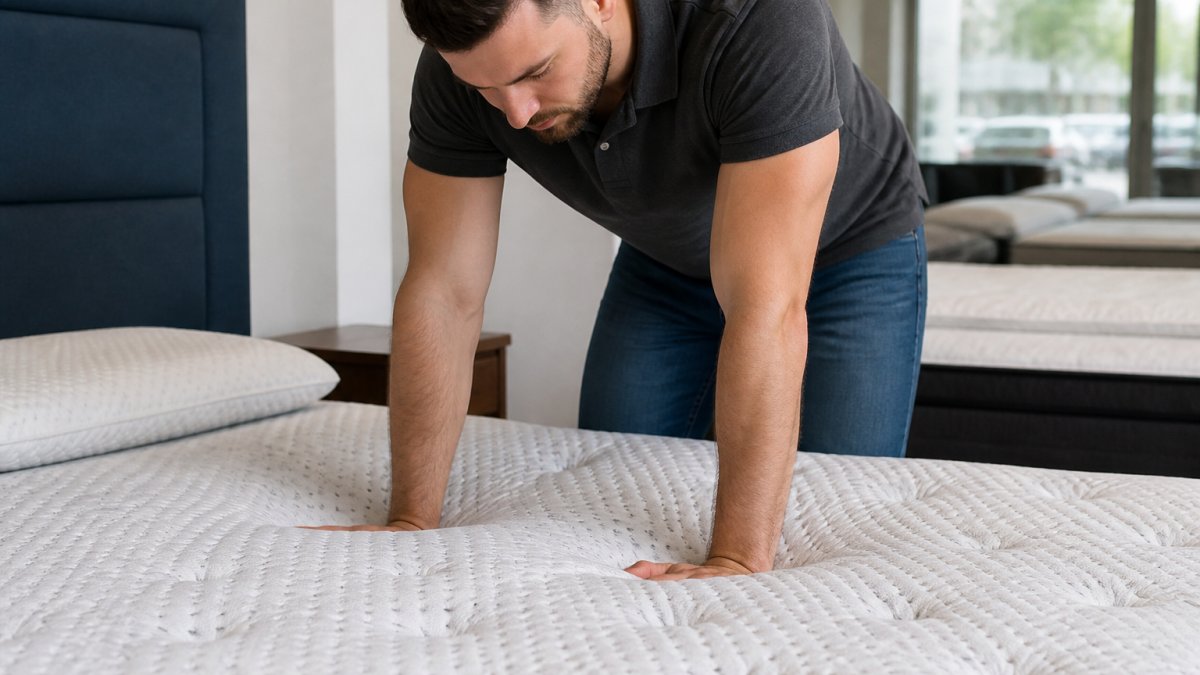
Firmness ratings vary between brands. A manufacturer’s rating reflects its own lineup, not an absolute scale. That is the caveat beginners need most: a 6 from one brand is not the same feel as a 6 from another, and two sleepers can rate the same bed a full point apart. Treat every number as a brand-specific label, not a measurement.
Construction changes the feel too.
A Beginner’s At-Home Decision Process
- Start with sleep position. Note whether you spend most of the night on your side, back, stomach, or a mix. This sets your starting range on the chart above.
- Adjust one step for body weight. Lighter sleepers lean one step softer; heavier sleepers lean one step firmer, because pressure into the comfort layers changes how firm the bed feels.
- Check pressure points. Lie in your dominant position for 15 minutes, not 15 seconds. Note any tingling, numbness, or concentrated pressure at the shoulders, hips, or heels.
- Check spinal alignment. Slide a hand under your lower back. A flat palm that passes with light resistance suggests good alignment; a big gap means too firm, and a hand you cannot move means too soft.
- Repeat for each position you actually sleep in, including your side, back, and stomach if you switch.
The Consumer Product Safety Commission publishes guidance on mattress flammability standards, and the U.S. Department of Health and Human Services maintains sleep health resources worth reviewing if pain is driving your purchase. Sleep position guidance from the American Academy of Orthopaedic Surgeons is also useful context for spinal alignment questions.
Couples, Hot Sleepers, and Special Cases: When One Firmness Doesn’t Fit All
- Split-firmness mattress: Two feels in one bed, usually split down the center or in a king/queen configuration. It solves the preference gap directly, but the seam can be noticeable to sleepers who drift toward the middle, and selection is narrower than in standard builds.
- Zoned support: The core firms up through the middle to hold the hips while the shoulder area stays softer. It helps combination sleepers and couples with moderate preference gaps, but zoning is fixed and cannot be tuned per person.
- Firm core plus a soft topper on one side: The most flexible and often the least expensive route. A topper can be swapped or removed as preferences change, though it adds height and can shift if not secured.
- Adjustable base: Lets each side change head and foot position rather than firmness itself. It helps with reflux, reading, and mobility, but it does not change how soft or hard the surface feels.
Our comparison of the best mattress for couples with different needs walks through split-firmness options, and hot sleepers can start with our picks for the best cooling mattresses for hot sleepers.
For any pain that is persistent or worsening, clinician guidance should come before a firmness decision, because no mattress rating is a medical treatment.
Find Your Firmness Before You Buy
Firmness is a starting point, not a finish line. The number on the tag tells you where to begin looking; your sleep position, body weight, and how the mattress is built decide where you land. Start with the chart, adjust one step for weight, test in your own bedroom, and give the bed two weeks before you judge it.
That’s where nearly a decade of mattress store ownership and more than 300 video reviews come in. Browse our video library before you commit, and sign up for our newsletter to get new reviews and coupon codes as they land.
Frequently Asked Questions
What is the mattress firmness scale?
The mattress firmness scale is a 1-10 rating system that describes how soft or firm a mattress feels when you lie on it. A 1 is the softest, most plush surface, and a 10 is the firmest. Most mattresses sold today land between 4 and 8. The scale measures feel, not support, so two mattresses rated 6 can still feel different depending on their materials and construction.
What mattress firmness is best for side sleepers?
Side sleepers usually do best in the 4-6 range, where the mattress cushions the shoulder and hip while keeping the spine level. A surface that is too firm presses into pressure points and can cause shoulder or hip pain. A surface that is too soft lets the hips sink and throws the spine out of alignment. Lighter side sleepers often prefer closer to 4, while heavier side sleepers may need a 6.
Do mattress firmness ratings vary between brands?
Yes. There is no standardized industry scale, so each manufacturer sets its own. A medium from one brand may feel firmer than a medium from another, and a 6 on a memory foam mattress can feel softer than a 6 on a hybrid. Always treat the number as a starting point, read the construction details, and use a sleep trial to confirm the feel on your own body.
How does body weight affect mattress firmness?
Body weight changes how far you sink into a mattress, so the same rating feels different from person to person. Sleepers under about 130 pounds often find medium-firm too hard and do better around 4-5. Sleepers between 130 and 230 pounds usually fit the 5-7 range. Sleepers above 230 pounds often need a 7-8 to get enough support and avoid sinking through the comfort layers.
Can a mattress topper change how firm a mattress feels?
A topper can shift the feel by roughly one to two points on the scale. A memory foam or pillow top topper softens a mattress that feels too firm, while a firm latex or high-density foam topper adds support to one that feels too soft. A topper is a practical fix for couples with different preferences or for testing a feel before committing to a new mattress.


Leave a Reply
Want to join the discussion?Feel free to contribute!