
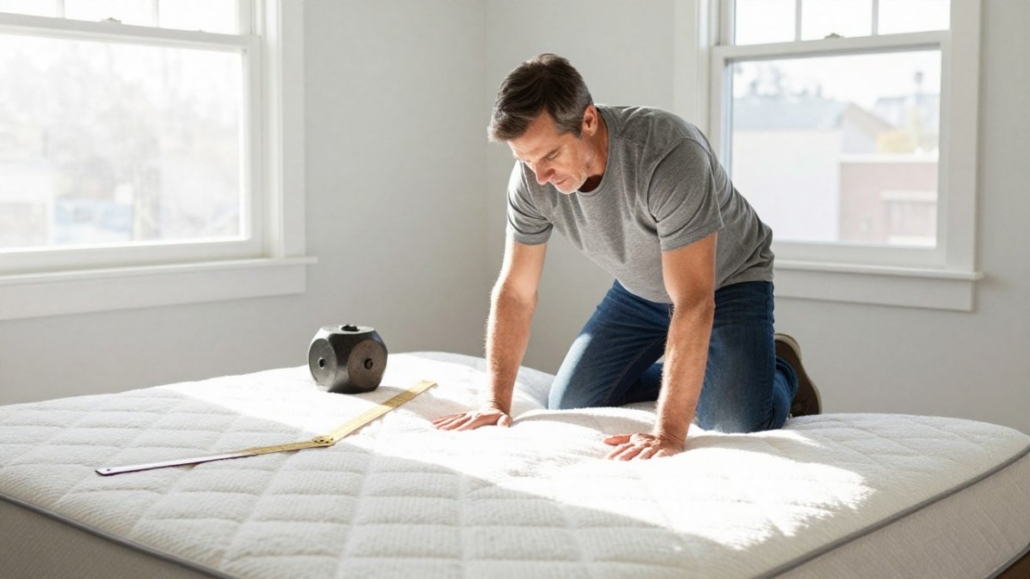
7 At-Home Mattress Tests That Reveal the Truth
Last Updated: November 12, 2026
Quick Summary
Run a structured seven-part mattress test at home covering visual condition, edge support, pressure relief, motion transfer, heat, firmness, and next-day symptoms. It takes about 20 minutes, and you should repeat it on at least three separate nights before drawing conclusions. Strip the bed to the bare surface first, since sheets hide sag and heat buildup.
- A dip deeper than about 1 inch usually signals worn support layers.
- Lie in your normal sleep position for a full 15 minutes without moving to check pressure points.
- Place a glass of water on the surface and have your partner roll over from 2 feet away to test motion transfer.
- Side sleepers usually need a softer surface, back sleepers medium firmness, and stomach sleepers a firmer surface.
- Keep a daily log for the first 30 nights tracking pain scores, temperature, and pressure points.
Table of Contents
- Set Up Your Bedroom Before You Run a Mattress Test
- The Seven-Part At-Home Mattress Test Protocol
- The Mattress Firmness Test: Match the Surface to Your Sleep Position
- How Long to Test a Mattress Before You Decide
- Use the Mattress Sleep Trial Without Wasting It
- Testing With a Partner Who Sleeps Differently
- Signs You Need a New Mattress, Not a New Pillow
- Track Your Results and Pick Your Next Mattress
- Frequently Asked Questions
Set Up Your Bedroom Before You Run a Mattress Test
You can learn more from one careful night of testing than from an hour of lying on a showroom floor. Learning how to test a mattress at home comes down to preparation, a repeatable set of checks, and honest notes about how your body feels the next morning.
Before you start, strip the bed down to the mattress surface. Sheets and mattress protectors hide sag, texture, and temperature buildup.
What to Have on Hand
- A tape measure
- A tennis ball or small weight
- A glass of water for motion checks
- A notebook or phone for notes
- A partner, if you share the bed
- A small fan or thermometer for heat tests
Give yourself two full nights before you form an opinion. One night tells you about novelty, not comfort.
The Seven-Part At-Home Mattress Test Protocol
The best at-home mattress test is a structured, seven-part routine that checks surface condition, edge support, pressure relief, motion transfer, heat, firmness, and next-day symptoms.
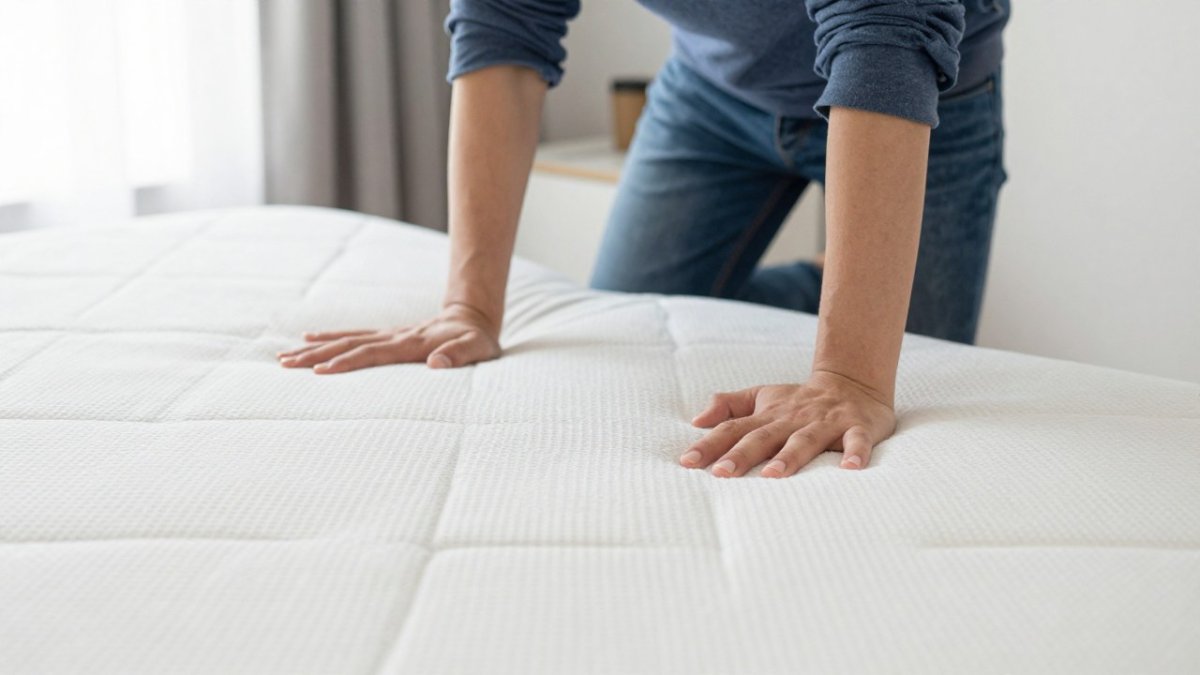
Here is the full sequence we walk readers through. It takes about 20 minutes, and you should repeat it on at least three separate nights before drawing conclusions.
| Step | What You Do | What It Reveals | Pass/Fail Criterion |
|---|---|---|---|
| 1. Visual check | Inspect seams, stains, and dips with a tape measure | Wear and hidden damage | No dip deeper than 1 inch; no visible tears or stains |
| 2. Edge check | Sit on each edge for 10 seconds, then press down with both hands | Edge support and roll-off risk | Edge should compress no more than 1-2 inches under seated weight |
| 3. Pressure test | Lie in your normal sleep position for 15 minutes without moving | Pressure points at hips and shoulders | No numbness, tingling, or sharp pressure that persists after you get up |
| 4. Motion test | Place a glass of water on the surface; have partner roll over from 2 feet away | Motion transfer | Water should not ripple enough to spill; less movement is better |
| 5. Heat test | Lie still for 10 minutes, then feel the surface under your back | Cooling and breathability | Surface should feel neutral or slightly warm, not hot or damp |
| 6. Firmness check | Compare feel to a firmness scale (1-10) while lying on your back | Whether it matches your needs | Spine should stay roughly straight with no gap or hard bridge |
| 7. Morning log | Record symptoms the next day within 30 minutes of waking | Real-world support and pain | No new pain that lasts more than 30 minutes after getting up |
If you want to see how a professional lab structures these checks, our guide on how we test mattresses walks through the full methodology.
Visual and Edge Checks
Start with your eyes and a tape measure. Run a hand along every seam and look for dips, lumps, or fraying. A dip deeper than about an inch usually signals worn support layers. Measure from the highest point of the mattress to the lowest point in the dip, don’t eyeball it.
Then sit on each edge for a full 10 seconds and press down with both hands. Good edge support keeps you from sliding off when you sit to tie shoes. Weak edges are common on older foam beds. A simple test: sit on the edge with your feet flat on the floor. If you feel yourself sliding forward or the edge compressing more than 2 inches, edge support is marginal.
For a deeper look at what is inside the bed, read our breakdown on how to compare mattress construction materials before you judge quality.
Pressure, Support and Motion Tests
Lie in your normal sleep position for a full 15 minutes without moving. This is the part most people skip. Notice pressure at your hips, shoulders, and heels.
Next, place a glass of water on the surface about 2 feet from your partner. Have your partner roll over from their side of the bed. Watch how much the water moves. Less movement means better motion isolation, which matters for couples.
Finally, lie still for 10 minutes and note warmth. Hot sleepers should pay close attention here. If the surface feels hot or damp under your back after 10 minutes, the mattress may not breathe well enough for you.
Watch out: testing on a cold mattress or in a cold room can make a firm bed feel firmer than it will at body temperature. If the heat test confirms that your mattress no longer feels comfortable, ND Junk Removals can help you consider what to do with it next.
The Mattress Firmness Test: Match the Surface to Your Sleep Position
The mattress firmness test is simple: lie on your back, slide a hand under your lower back, and check whether your spine stays roughly straight. A good match keeps your ears, shoulders, and hips aligned without a gap or a hard bridge.
Sleep position drives the target:
- Side sleepers usually need a softer surface to cushion shoulders and hips
- Back sleepers do best with medium firmness for lumbar support
- Stomach sleepers need a firmer surface to keep the hips from sinking
If the scale confuses you, our guide on the mattress firmness scale for beginners explains each level in plain terms.
How Long to Test a Mattress Before You Decide
Give a new mattress a few weeks before you judge it. Your body needs time to adjust to a new surface, and early soreness is common in the first week.
Judge in stages:
- Nights 1-7: expect adjustment, not verdict
- Nights 8-21: note patterns in pain and sleep quality
- Nights 22-30: decide based on consistent results
A single bad night means little. A repeating pattern means something.
Use the Mattress Sleep Trial Without Wasting It
A mattress sleep trial is a return window, not a free rental.
To use a trial well, treat it like a structured experiment. Keep a simple daily log for the first 30 nights. A notebook or phone note works fine. Track these five fields each morning:
- Date and hours slept
- Pain score (0-10) for back, hips, shoulders, and neck
- Temperature: did you wake up hot, cold, or comfortable?
- Pressure points: any numbness or tingling, and where?
- One sentence on how rested you felt
After two weeks, look for patterns. A single bad night means little. A repeating pattern, same pain location, same time of night, means something. This log is also your evidence if you need to contact support.
Before you return, check the trial conditions. Most brands require the mattress to be clean and undamaged. Know your retailer’s trial rules before night one so you do not void the trial by accident.
Watch out: the most common trial mistake is waiting until the last week to start logging.
Separate Mattress Issues From Other Sleep Factors
Not every sleep problem is the mattress. Before you blame the bed, rule out the other variables. Pillows affect neck alignment, a pillow that is too high or too flat can cause the same morning stiffness you might attribute to the mattress. Bed frames and foundations affect support; a sagging box spring can make a good mattress feel bad. Room temperature and bedding affect heat retention.
A practical way to isolate the mattress: sleep on the same bed for three nights with your usual pillow and bedding, then swap one variable at a time (pillow first, then bedding, then room temperature). If the pain follows the mattress across all three nights regardless of the other variables, the mattress is the likely cause. If the pain changes when you swap the pillow, the pillow is the culprit.
This step matters because returning a mattress is a hassle, and many people return a bed that was fine once they fixed their pillow or foundation. Run the isolation check before you contact support.
Testing With a Partner Who Sleeps Differently
Couples rarely want the same surface. One partner runs hot while the other wants firm support. Test the bed together, not separately.
Try these checks as a pair:
- Take turns lying in your own sleep position
- Roll toward each other and note motion transfer
- Check whether one side sinks more than the other
- Compare temperature after 10 minutes
If your needs clash, our guide on the best mattress for couples with different needs covers split-firmness options and how to choose between them.
Signs You Need a New Mattress, Not a New Pillow
The signs you need a new mattress usually show up as patterns, not one-off nights. Watch for these:
- Waking with back or hip pain that fades during the day
- Visible sagging or a dip where you sleep
- Feeling springs or hard spots through the surface
- Allergy symptoms that ease when you sleep elsewhere
- Restless nights that started when the bed got older
A new pillow can help neck pain. It cannot fix a collapsed support layer.
Track Your Results and Pick Your Next Mattress
Notes beat memory every time. Keep a simple log: date, hours slept, pain score, temperature, and one sentence on how you felt. After two to three weeks, patterns appear.
Once you have your results, turn them into a shortlist. Take our mattress finder quiz to match your firmness, sleep position, and cooling needs to real options, then check our video reviews before you buy.
Testing a mattress at home takes patience, but the payoff is a bed that actually fits your body. Real Mattress Reviews exists to make that decision easier, with nearly a decade of store experience, more than 300 video reviews, and coupon codes that help you save.
Frequently Asked Questions
What is the best way to test a mattress at home?
Run a structured mattress test instead of lying down once. Check the surface for sagging and edge collapse, press the center to see how fast it recovers, then lie in your normal sleep position for at least 15 minutes per side. Note pressure points at the hips and shoulders, whether your lower back feels supported, and how much movement you feel from a partner. Repeat the same checks on three or four different nights so one bad night does not skew your verdict.
How long should you lay on a mattress to test it?
Give each position at least 15 minutes. Short lie-downs mostly measure first impressions, and foam and hybrid surfaces need time to respond to your body heat. Roll from your back to each side and onto your stomach, spending the full 15 minutes in whichever position you actually sleep in. If you are comparing two mattresses, keep the time identical for both so the comparison is fair.
How do I know if a mattress supports my back?
Lie on your back and slide a hand under your lower back. A small gap is normal; a gap you can push a whole arm through means the surface is too firm, while a hand you cannot move at all means it is too soft. Your spine should feel roughly level, not arched or sunk at the hips. If you wake with stiffness that eases within an hour of getting up, the mattress is a likely contributor worth tracking.
Can you return a mattress after sleeping on it?
Sleep trial terms vary by retailer, so check the rules before you buy. Read the fine print on return shipping fees, whether the law tag must stay attached, and whether the mattress is donated or picked up. Keep the original packaging advice and your order confirmation so a return is straightforward if the trial does not work out.


Leave a Reply
Want to join the discussion?Feel free to contribute!