
How to Handle a Failed Mattress Trial and Get a Refund
Last Updated: November 19, 2026
Quick Summary
If your mattress trial fails, contact the seller in writing within 48 hours and start a dated paper trail. Email customer service stating your intent to return, photograph the mattress and law tags, and ask for the return authorization number in writing. Speed matters because most return windows are counted in nights, not weeks.
- Many sellers block returns before a minimum break-in period, commonly 21 to 30 nights.
- The maximum return window is usually counted from the delivery date, not the order date.
- Stains, tears, burns, and missing law tags are the most common reasons a return gets rejected.
- Read for four separate fees: restocking, pickup, original shipping, and disposal or donation.
- If a return is denied, get the denial in writing and ask for a supervisor review.
Table of Contents
- Your First 48 Hours: A Time-Sensitive Action Plan
- Understanding Your Mattress Trial Return Policy
- How to Write a Mattress Trial Return Request Email
- What to Expect: Mattress Trial Period Length and Deadlines
- How to Return a Mattress That Came in a Box
- Documenting Defects and Dissatisfaction: A Checklist
- When a Return Is Denied: Escalation Options
- Next Steps: Get Help Choosing Your Replacement Mattress
- Frequently Asked Questions
Your First 48 Hours: A Time-Sensitive Action Plan
If your mattress trial has failed, contact the seller in writing within 48 hours and start a dated paper trail. Speed matters more than certainty here. Most return windows are counted in nights, not weeks, and a slow start can cost you the refund.
Mattress trials are generous on paper and strict in practice. A mattress trial is a set period, usually 30 to 365 nights, during which you can return a mattress you bought online. Most policies require a minimum break-in period of two to three weeks before you can even ask for a return, according to SweetNight’s guide to how sleep trials work. So the clock cuts both ways.
Here is what to do first, in order:
- Find your order confirmation and note the delivery date.
- Read the trial terms on the seller’s site, not the sales page.
- Email customer service today stating your intent to return.
- Photograph the mattress and your law tags.
- Ask for the return authorization number in writing.
At Real Mattress Reviews, we have spent nearly a decade helping shoppers read the fine print before and after the sale. Below, we walk through each step, the exact emails to send, and what to do if the seller says no.
Here is the order of actions to take in the first 48 hours after a failed mattress trial.
| Step | What to do |
|---|---|
| 1 | Find order confirmation and note delivery date |
| 2 | Read trial terms on the seller’s site |
| 3 | Email customer service stating intent to return |
| 4 | Photograph the mattress and law tags |
| 5 | Ask for return authorization number in writing |
Understanding Your Mattress Trial Return Policy
A mattress trial return policy is the written set of rules that decides whether you get money back. It is not the same as the warranty, and it is not the same as the sales pitch.
1. The minimum break-in period. Many sellers block returns before a set number of nights, commonly 21 to 30. This is not a grace period for the seller; it is a condition you must satisfy before a return request is even valid.
2. The maximum return window. This is your deadline, and it is usually counted from the delivery date rather than the order date. A 120-night trial with a 30-night minimum and a two-week delivery leaves you roughly 76 usable nights to decide and act.
3. The condition rules. Stains, tears, burns, and missing law tags are the most common reasons a return gets rejected. Consumer guidance on what voids a mattress trial points to removed law tags, stains, and physical damage as the usual culprits.
4. The fees, which are separate line items. Do not treat “free returns” as one number.
5. The refund type and timing. Confirm whether you get a full refund to the original payment method, a partial refund after deductions, or store credit only.
6. The exclusions that void the trial entirely. These are different from condition rules.
Watch out: a policy page and a sales page often disagree, and the sales page is not the contract.
The fine print is where trials die, but it is also where a prepared reader wins. Write the six terms above into a single note with your own dates filled in, and you will know within ten minutes whether your return is clean, conditional, or already void.
How to Write a Mattress Trial Return Request Email
A mattress trial return request email should be short, factual, and dated. Put your order number in the subject line and state your request in the first sentence.
Use this template:
Subject: Return Request – Order #[number] – Delivered [date]
Hello,
I am requesting a return under your [X]-night trial for the mattress delivered on [date]. I have slept on it for [number] nights and it is not working for me.
Order number: [number]
Delivery date: [date]
Reason: [pain, sagging, firmness, heat]Please send me the return authorization number and confirm the pickup window, any fees, and the refund amount and timing.
Thank you,
[Name]
[Phone]
Keep every reply. If the seller calls, follow up with an email that summarizes what was said. Written confirmation is your use later.
What to Expect: Mattress Trial Period Length and Deadlines
Most mattress trial periods run 30 to 365 nights, and the countdown usually starts on the delivery date, not the order date. Trial lengths commonly range, per Nectar Sleep’s trial policy.
Deadlines are the part shoppers miss. A 120-night trial sounds endless until you subtract the 30-night minimum and a slow two-week delivery. Suddenly you have a narrow window to act.
Track three dates on a calendar:
- Delivery date: day one of the trial.
- Minimum date: the first day you can request a return.
- Deadline: the last day to request one.
Set a reminder one week before the deadline. Do not wait for the mattress to “break in” past that point.
How to Return a Mattress That Came in a Box
Returning a bed-in-a-box mattress is easier than returning a traditional one. You do not ship it back yourself. The seller arranges pickup, and you leave the mattress at the door.
The standard steps:
- Get your return authorization number by email.
- Confirm the pickup date and address in writing.
- Deflate or bag the mattress if the seller asks.
- Keep the law tags attached until pickup.
- Photograph the mattress on pickup day.
- Confirm the refund in writing after pickup.
Some sellers ask you to donate the mattress instead. Get that instruction in writing too. If you are wondering whether a boxed mattress holds up long enough to be worth the hassle, our guide on whether bed in a box mattresses are durable covers what to expect.
Documenting Defects and Dissatisfaction: A Checklist
Documentation wins disputes. Photograph everything before you make the call, and keep the files dated.
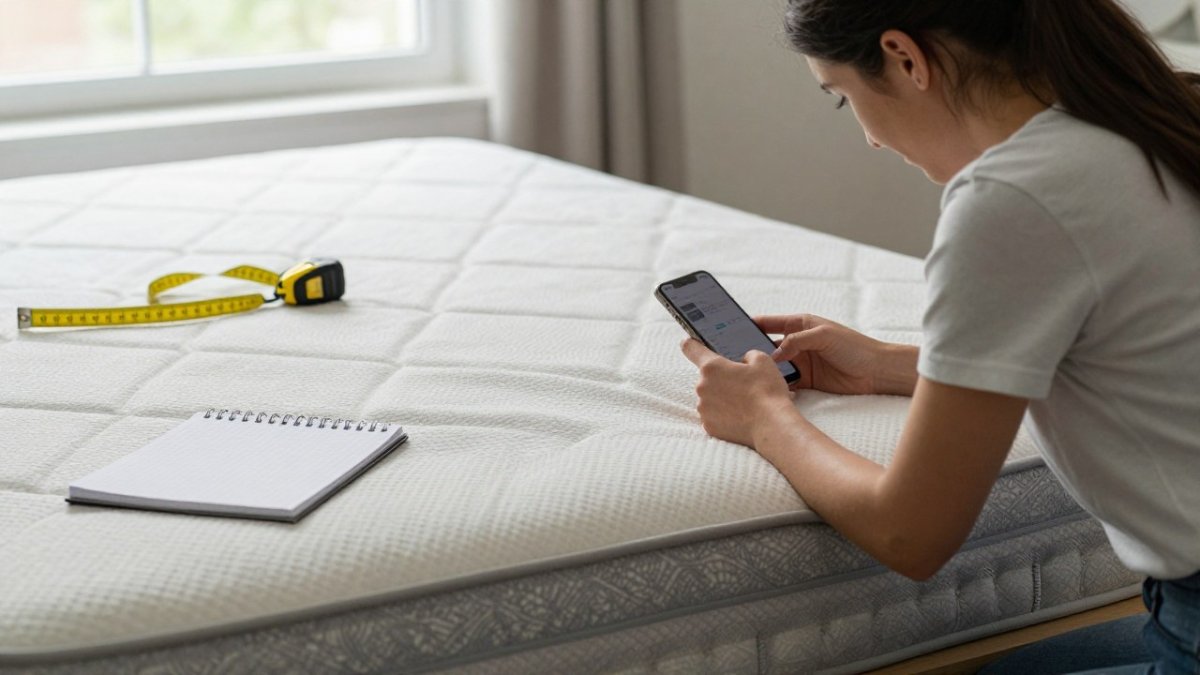
Use this checklist:
- Photos of the law tags, still attached
- Photos of any stains or damage, close up
- A photo of a straight edge across the sag, with a tape measure
- Your order confirmation and delivery receipt
- A sleep log noting pain, heat, or sagging by date
- Copies of every email and chat transcript
- Notes from any phone call, with the date and rep name
A common mistake is waiting until the mattress looks bad to start documenting. Start on day one. Watch out: stains and damage you cannot document can make a return harder to win.
When a Return Is Denied: Escalation Options
If a return is denied, the first move is not to argue. It is to get the denial in writing and make the seller name the exact policy clause they are relying on.
Work through these steps in order, and give each one a reasonable window before moving to the next.
Step 1: Request the denial in writing and ask for a supervisor review. Front-line representatives often lack the authority to override a policy, and a written request creates a record.
Step 3: File a dispute with your card issuer, if the seller broke its own written policy. This is a chargeback, and it is appropriate when you have documentation showing the seller’s stated policy allowed the return and the seller refused anyway.
Step 4: Contact your state attorney general’s consumer protection office. This is a formal complaint, not a threat, and it is most useful when a seller has a pattern of denying returns that its own policy allows.
Step 5: Leave a factual review. Dates, order numbers, and the exact policy language, with no emotion. A factual review is both a record and a signal to other shoppers, and some sellers respond to it directly.
Watch out: do not cancel the payment or stop paying a financing plan before you have a written denial and a documented dispute. Doing so can damage your credit or hand the seller a reason to refuse on unrelated grounds.
Before you escalate, check whether the reviews you trusted were reliable at all. Our breakdown of why mattress reviews are often unreliable and our guide to spotting biased online mattress reviews explain what to look for.
If the deadline has already passed, the same steps apply, but lead with a request for a discretionary exception rather than a demand.
Next Steps: Get Help Choosing Your Replacement Mattress
A failed trial is not a failed purchase. It is data. You now know your firmness preference, your heat tolerance, and how your body reacts after 30 nights.
Before you buy again, do three things:
- Write down what failed: too firm, too soft, too hot, or sagging.
- Filter your shortlist by that one flaw first.
- Check the trial terms before the price.
Our mattress reviews library covers more than 300 models in video form, so you can compare how each one handles back pain, heat, and firmness before you commit. When you are ready to buy, our mattress coupons page collects working discount codes for the major online brands.
A failed mattress trial tests your patience, but the process rewards anyone who acts fast and keeps records. At Real Mattress Reviews, we built our library of over 300 video reviews and our exclusive coupon codes to help you pick a mattress that fits the first time. Compare models side by side, check the trial terms before you buy, and save with verified discount codes. Get started with Real Mattress Reviews and choose your next mattress with confidence.
Frequently Asked Questions
What should I do if I don’t like my mattress during the trial period?
Contact the retailer as soon as you decide the mattress isn’t working, but check the minimum trial period first. Many policies require a minimum break-in period before a return request, so check yours and use that time to test different sleeping positions. Before you call, photograph the mattress, locate your order confirmation, and review the return policy for fees. Then send a written return request email so you have a timestamped record of the conversation.
Can I return a mattress after the sleep trial expires?
Generally, no. Once the mattress trial period ends, the return window is closed and the retailer is not obligated to accept the mattress back. Your remaining options are a warranty claim if there is a material defect like sagging, or reselling the mattress yourself. This is why tracking your delivery date and the trial expiration date matters so much. Set a calendar reminder a week before the deadline so you never miss it.
Do mattress companies charge fees for trial-period returns?
Some do, some don’t. Read the fine print for restocking fees, return shipping costs, and pickup fees before you buy. Many policies offer a full refund but deduct a fee if the mattress is stained, damaged, or missing its law tag. If you are returning a mattress that came in a box, ask whether you need to repackage it or whether the company arranges pickup. Get any fee quoted in writing before you schedule the return.
How do I prove that a mattress is defective?
Document the defect with dated photos and a short video. For sagging, place a straight edge or level across the mattress and photograph the gap with a measuring tape in frame. Keep your order confirmation and delivery date handy, since warranties often require a minimum break-in period. Send everything in one email to customer service and ask for written confirmation of the next step. If the claim is denied, escalate to a store manager or use the payment dispute process with your card issuer.
