

How to Choose a Mattress for Hot Sleepers: 2026 Guide
Table of Contents
- Start With Why You Overheat: Mattress Heat vs. Other Causes
- Mattress Materials for Hot Sleepers: What Traps Heat and What Breathes
- Cooling Mattress Features That Actually Make a Difference
- Mattress Firmness for Hot Sleepers: Finding the Right Balance
- Test Before You Buy: A Step-by-Step Selection Process
- Step 1: Rule Out Non-Mattress Heat First
- Step 2: Classify Your Heat Pattern
- Step 3: Set a Budget Before You Compare
- Step 4: Match Construction to Your Heat Level
- Step 5: Match Firmness to Position and Body Weight
- Step 6: Verify the Cooling Specs, Not the Labels
- Step 7: Use the Trial and Read the Fine Print
- Step 8: Plan the Rest of the Sleep System
- Quick Trade-Off Checklist
- Add a Cooling Mattress Topper Without Masking Support Problems
- Build a Complete Cooling Sleep System
- Conclusion
- Frequently Asked Questions
Last Updated: October 18, 2026
Start With Why You Overheat: Mattress Heat vs. Other Causes
Before you shop for a mattress for hot sleepers, rule out what a new bed can’t fix: room temperature, bedding, pajamas, and a partner’s body heat.
Mattress-related heat builds where your body meets the sleep surface, from trapped air and heat retention in dense materials.
Other causes show different patterns. A warm room, heavy comforter, or synthetic sheets raise your temperature everywhere, not just at contact points.
Signs Your Mattress Is the Heat Source
Watch for these signals:
- You flip the pillow and kick off covers within the first hour
- The mattress feels warm to the touch when you get in
- You sleep cooler on hotel beds
If most fit, the mattress is trapping heat. If not, look at the room first.
Mattress Materials for Hot Sleepers: What Traps Heat and What Breathes
Material choice matters more than any cooling marketing claim.
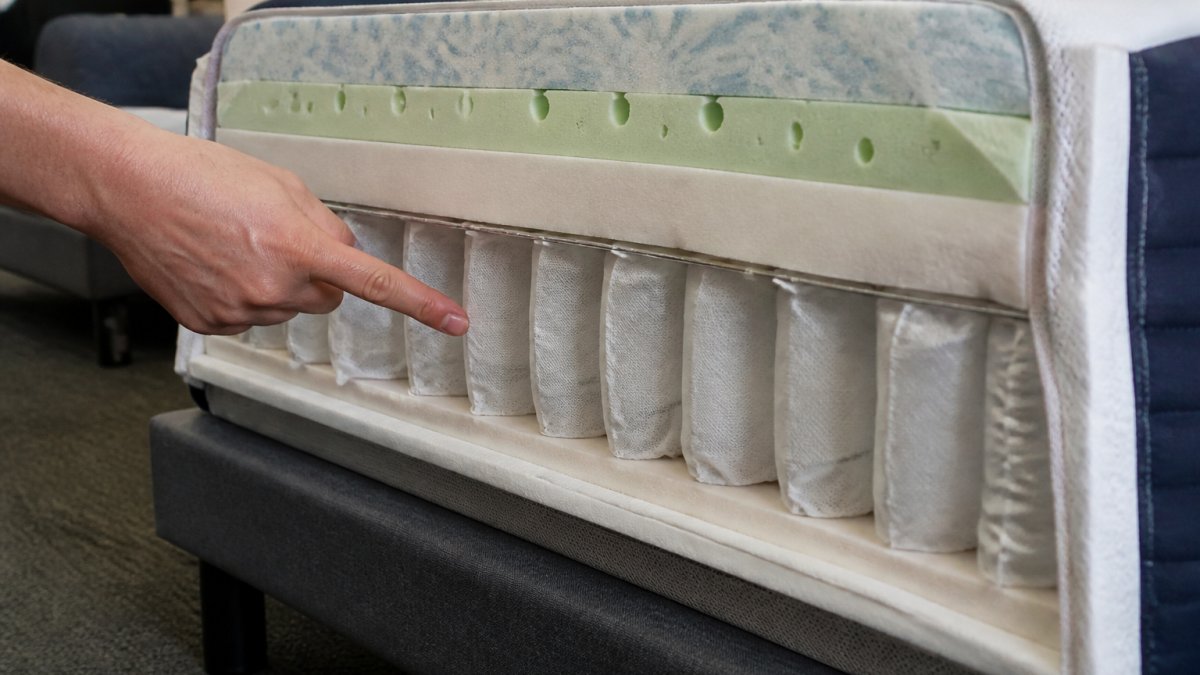
Memory foam is the biggest heat retainer.
Polyfoam is lighter and more open than memory foam, though cheap high-density polyfoam can still run warm.
Latex foam has an open-cell structure that lets air move, sleeping notably cooler than memory foam.
Coil systems are the strongest cooling asset in any bed.
Foam, Latex, and Coil Systems Compared
| Material | Heat Retention | Breathability | Feel |
|---|---|---|---|
| Memory foam | High | Low | Contouring, slow response |
| Gel memory foam | Medium-high | Low-medium | Contouring with slight cooling |
| Polyfoam | Medium | Medium | Balanced |
| Latex foam | Low-medium | High | Bouncy, responsive |
| Coil / hybrid | Low | High | Supportive, airflow-rich |
The pattern is simple: the more open the structure, the cooler you sleep.
Cooling Mattress Features That Actually Make a Difference
Cooling mattress features vary widely. The difference usually comes down to whether a feature moves heat away from your body or merely feels cool for the first few minutes.
The Three Mechanisms That Actually Cool a Bed
Legitimate cooling features work through one of three mechanisms:
- Airflow. A coil support core, ventilated base, or open-cell foam lets air move through the bed, carrying heat away. It’s the most durable mechanism because it doesn’t wear out.
- Moisture movement. Moisture-wicking covers and sheets pull sweat away so it can evaporate, changing how you feel even without lowering mattress temperature.
- Heat absorption and release. Phase-change materials absorb heat as you warm the surface and release it as you cool, smoothing temperature swings. The effect is real but limited to the layer where the material sits and fades once saturated.
If a feature doesn’t do one of these three things, it is probably a feel claim rather than a cooling claim.
Features That Generally Help
- Coil support cores that keep air moving beneath the foam layers, the strongest, most durable cooling asset in any bed.
- Breathable cooling covers made from moisture-wicking fabrics that pull sweat away from the sleep surface.
- Gel-infused or open-cell foams that reduce heat buildup versus traditional memory foam.
Features to Treat With Skepticism
- Vague “cooling technology” labels with no material explanation.
- Thin cooling covers layered over dense memory foam, the cover feels cool, the foam underneath still traps heat.
- Claims of a “temperature-neutral” bed with no airflow path.
Cooling Claims vs. Measurable Performance
Cooling claims are hard to verify because there is no standard test for mattress surface temperature. Ask what does the cooling: the cover, the foam, or the coil system. If the answer is “the cover” alone, expect limited relief.
A useful habit is to translate marketing terms into mechanisms:
| Marketing Term | What It Should Mean | What to Verify |
|---|---|---|
| “Cooling” | Moves heat or moisture away | Which layer does it, and how |
| “Temperature-neutral” | Doesn’t add heat | Airflow path through the bed |
| “Phase-change” | Absorbs and releases heat | Where the material sits and how much is used |
| “Breathable” | Air moves through | Open-cell foam or coil core |
| “Moisture-wicking” | Pulls sweat off the skin | Fabric composition and cover construction |
If a product page can’t answer the “what to verify” column, treat the claim as unproven.
The most common mistake is buying a bed for its cooling cover while ignoring the foam underneath. A breathable cover over dense memory foam still traps heat. Check the full construction, not just the top layer.
Long-Term Cooling Performance
Cooling performance can change after break-in. Foam softens and airflow paths narrow as the comfort layer compresses, so a bed that sleeps cool in month one can run warmer in year three. Beds with coil cores and open-cell foams hold their cooling longer because the airflow path is structural. In reviews, look for owners past the one-year mark.
A Simple Evidence Test Before You Buy
Use these four questions on any product page or in any store:
- What is the cooling mechanism, airflow, moisture movement, or heat absorption?
- Which layer contains it, and how thick is that layer?
- Is there a continuous airflow path from the top layer to the base?
- Do long-term owner reviews still describe the bed as cool after a year?
If you can’t answer two or more, treat the cooling label as marketing.
Mattress Firmness for Hot Sleepers: Finding the Right Balance
Mattress firmness for hot sleepers is about contact area. Too soft wraps you in foam and traps heat; too firm creates pressure points that make you toss and turn, which also raises body temperature.
For most hot sleepers, medium to medium-firm is the sweet spot: spinal alignment without deep sinkage, so air keeps moving. Side sleepers may prefer slightly softer for shoulder and hip pressure relief; back and stomach sleepers usually do better with medium-firm or firm.
Body weight changes the equation. Lighter sleepers sink less and can handle softer beds; heavier sleepers benefit from firmer support with strong coils.
Test Before You Buy: A Step-by-Step Selection Process
This decision process is built around the four variables that change how warm you sleep, heat pattern, sleep position, body weight, and budget.
Step 1: Rule Out Non-Mattress Heat First
Spend three nights testing the room and bedding: lower the thermostat, switch to a lightweight breathable comforter, and try moisture-wicking sheets. If you still wake up hot at the contact points, shoulders, hips, mid-back, the mattress is the likely culprit. Full-body heat points to the environment.
Step 2: Classify Your Heat Pattern
Use this quick diagnostic to decide how much cooling performance you actually need:
| Pattern | What It Suggests | Priority |
|---|---|---|
| Heat builds under shoulders and hips only | Contact-point heat from dense foam | High, prioritize coils and open-cell foam |
| You wake up sweaty across your whole body | Room, bedding, or health factor | Medium, fix environment first, then upgrade |
| You sleep hot only in summer | Seasonal, bedding-driven | Low, start with a cooling topper and sheets |
| Your partner sleeps cool on the same bed | Mattress is trapping your heat specifically | High, construction is the issue |
| You overheat on every bed you’ve owned | Could be medical or medication-related | Talk to a clinician before buying |
That last row matters. Some medications and health conditions raise body temperature at night regardless of the mattress. A new bed won’t fix that, and a clinician is the right first call.
Step 3: Set a Budget Before You Compare
Cooling performance is not strictly tied to price. A well-built hybrid with a coil core and breathable cover can outperform a pricier all-foam bed with a phase-change cover, because the coil layer does the airflow work. Decide your ceiling first, then filter by construction. Mid-range hybrids and latex beds deliver most of the cooling benefit.
Step 4: Match Construction to Your Heat Level
- Runs very hot: prioritize a hybrid with a genuine coil support core, open-cell or gel foam, and a breathable cover. Avoid all-foam memory foam.
- Runs moderately warm: a hybrid or a latex bed works; you can accept a thin comfort layer of foam if the coil layer is substantial.
- Runs warm only occasionally: a breathable all-foam bed with open-cell foam plus cooling bedding may be enough.
Step 5: Match Firmness to Position and Body Weight
Firmness controls how far you sink, and sinkage controls how much foam wraps around you and traps heat.
- Side sleepers: medium to medium-soft for shoulder and hip pressure relief, but not so soft that you sink past the comfort layer.
- Back sleepers: medium to medium-firm for spinal alignment with limited sinkage.
- Stomach sleepers: medium-firm to firm to keep the hips from dropping.
Step 6: Verify the Cooling Specs, Not the Labels
Ask three questions about any bed marketed as cooling: What does the cooling, the cover, the foam, or the coil system? Is there a continuous airflow path from top to base? Does the cover stay breathable after a protector and sheets are added? If the answer is “the cover” alone, expect limited relief.
Step 7: Use the Trial and Read the Fine Print
Most online brands offer a sleep trial, but terms vary. Confirm the trial length, return fees, minimum nights, and warranty coverage. Sleep on the new bed at least two weeks before judging temperature, the first few nights run warm as your body adjusts.
Step 8: Plan the Rest of the Sleep System
Before you finalize, budget for moisture-wicking sheets, a breathable protector, a cooling pillow, and a fan or room ventilation. These compound with a well-chosen mattress and are often cheaper than upgrading a tier.
Write your four variables down before you shop, heat pattern, position, body weight, budget. Every product page you open should be judged against those four, not against the loudest cooling claim.
Quick Trade-Off Checklist
Cooling rarely comes free. Weigh these trade-offs:
- Cooling vs. pressure relief: very firm, airflow-rich beds can create pressure points for side sleepers.
- Cooling vs. motion isolation: coils move air but transfer motion more than foam; couples should test this.
- Cooling vs. noise: some airflow-friendly designs are louder than all-foam beds.
Run the checklist against your four variables, and the choice usually narrows to two or three beds before you ever lie down.
Add a Cooling Mattress Topper Without Masking Support Problems
A cooling mattress topper can lower surface temperature, but it cannot fix a sagging or unsupportive bed. Use one when the mattress is supportive but runs warm, and look for breathable, moisture-wicking materials rather than dense memory foam. If your mattress sags or causes pressure pain, put the money toward a new mattress instead.
Build a Complete Cooling Sleep System
A complete cooling sleep system combines the bed with bedding and room conditions. Start with moisture-wicking sheets and a lightweight, breathable comforter; skip heavy synthetics. Keep the room cool, use a fan, and choose a cooling pillow with breathable fill.
The U.S. Department of Energy’s guidance on home cooling explains how air circulation and thermostat settings affect room comfort, which directly influences how warm you sleep. For shoppers weighing options, a Consumer Reports overview of mattress buying is a useful neutral reference on trials and returns.
Cooling works best as a system. A breathable mattress, moisture-wicking bedding, and a cool room together do more than any single “cooling” feature.
Conclusion
Choosing a mattress for hot sleepers comes down to construction, firmness, and a complete sleep system, not marketing labels. Real Mattress Reviews exists to prevent the guess-and-regret cycle: our library of over 300 video reviews and nearly a decade of store ownership help you compare real beds across sleep positions and body types, and our exclusive coupon codes save you money when you buy.
Frequently Asked Questions
What type of mattress is best for hot sleepers?
Hybrid and innerspring mattresses with strong coil airflow generally sleep cooler than all-foam beds because air moves through the support core. Look for breathable covers, gel-infused or open-cell foams, and a firm enough surface that you don’t sink into heat-trapping layers. A cooling mattress topper can help, but only after you’ve confirmed the mattress itself provides proper support and temperature regulation.
Which mattress materials sleep the coolest?
Latex foam, polyfoam with open-cell designs, and coil systems tend to sleep cooler than traditional memory foam, which can retain heat. Gel-infused foams and phase-change materials may help with surface temperature, but their effect varies. Breathability comes from the combination of cover fabric, foam structure, and airflow through the support core, so check the full construction rather than a single material claim.
Does memory foam make you sleep hotter?
Traditional memory foam can sleep hot because it conforms closely to your body and limits airflow, trapping heat around the sleep surface. Newer open-cell and gel-infused memory foams reduce this effect, but they still tend to retain more heat than latex or coil-based designs. If you overheat easily, consider a hybrid mattress with a thin memory foam comfort layer over a breathable coil core.
Can a mattress topper help you sleep cooler?
A cooling mattress topper can improve surface temperature and moisture wicking, especially if it uses breathable foams, gel, or phase-change materials. However, a topper cannot fix a mattress that lacks support or traps heat in its core. Use a topper as part of a complete sleep system, and address firmness, bedding, and room temperature first.
Ready to stop overheating at night? Sign up for the Real Mattress Reviews newsletter for new video reviews, cooling tips, and current coupon codes delivered to your inbox.


Leave a Reply
Want to join the discussion?Feel free to contribute!